
 Sign in with Google
Types of Pharmaceutical Companies (Innovator, Generic, CRO, Biotech)
The pharmaceutical industry is made up of different types of companies, each performing a specialized role in the discovery, development, testing, manufacturing, and distribution of medicines. These companies operate at different stages of the drug lifecycle and often collaborate with one another to bring safe and effective treatments to patients.
Research-based or innovator pharmaceutical companies are primarily focused on discovering and developing new medicines. These organizations invest heavily in research and development, including preclinical studies and multi-phase clinical trials, to prove the safety and effectiveness of their products. Once a new drug is approved, they receive patent protection, which allows them to exclusively market the medicine for a certain period. This model involves high risk and significant investment, but it also offers high profit potential if the drug becomes successful. Well-known examples of innovator companies include Pfizer, Novartis, and Roche.
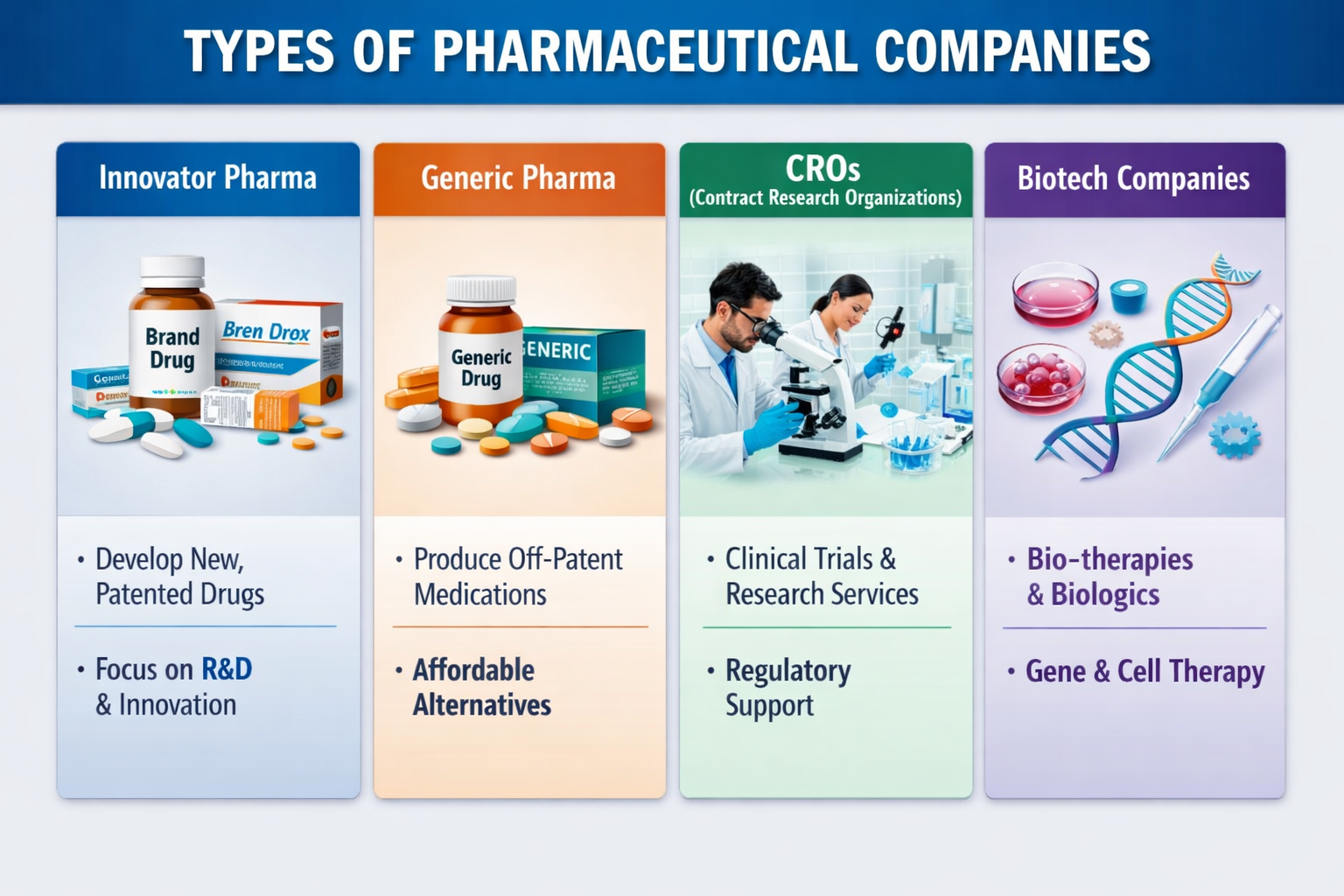
Generic pharmaceutical companies play a different but equally important role. Instead of discovering new drugs, they manufacture affordable versions of medicines after the original patents expire. These companies conduct bioequivalence studies to demonstrate that their products work in the same way as the original branded drugs. They submit abbreviated applications, such as the Abbreviated New Drug Application (ANDA), to regulatory authorities for approval. Their primary focus is on large-scale production, cost efficiency, and accessibility. Major generic pharmaceutical companies include Sun Pharmaceutical Industries, Teva Pharmaceutical Industries, and Cipla.
Contract Research Organizations, commonly known as CROs, provide outsourced research services to pharmaceutical and biotechnology companies. These organizations help manage clinical trials, collect and analyze data, and provide regulatory and pharmacovigilance support. CROs allow drug companies to reduce costs and speed up the research process by outsourcing specialized tasks. One of the leading examples of a CRO is IQVIA, which offers a wide range of clinical research and data services.
Biotechnology companies focus on the development of biologics, which are medicines derived from living organisms. Their work includes vaccines, monoclonal antibodies, cell therapies, and gene therapies. These companies use advanced biotechnology techniques to create highly targeted treatments, often for complex or rare diseases. Because biologics are more complex to produce than traditional chemical drugs, they are typically more expensive and require specialized manufacturing processes. Prominent biotechnology companies include Amgen and Biogen.
To better understand the differences between these company types, the following table presents a structured comparison:
| Company Type | Primary Focus | Key Activities | Risk & Investment | Example Companies |
|---|---|---|---|---|
| Innovator (Research-Based) | Discovering new drugs | R&D, clinical trials, patent-protected products | High risk, high investment, high return potential | Pfizer, Novartis, Roche |
| Generic Companies | Low-cost versions of existing drugs | Bioequivalence studies, large-scale manufacturing, ANDA filings | Lower risk, cost-focused model | Sun Pharma, Teva, Cipla |
| CROs | Outsourced research services | Clinical trials, data management, regulatory support | Service-based, moderate risk | IQVIA |
| Biotechnology Companies | Biologic and advanced therapies | Vaccines, monoclonal antibodies, gene and cell therapies | High complexity and investment | Amgen, Biogen |
Together, these different types of companies form an interconnected ecosystem that drives pharmaceutical innovation, ensures regulatory compliance, and makes medicines available to patients around the world.
