
 Sign in with Google
Pharmaceutical Product Types: Tablets, Capsules, Injectables, Biologics, Biosimilars
Pharmaceutical Products and Their Types
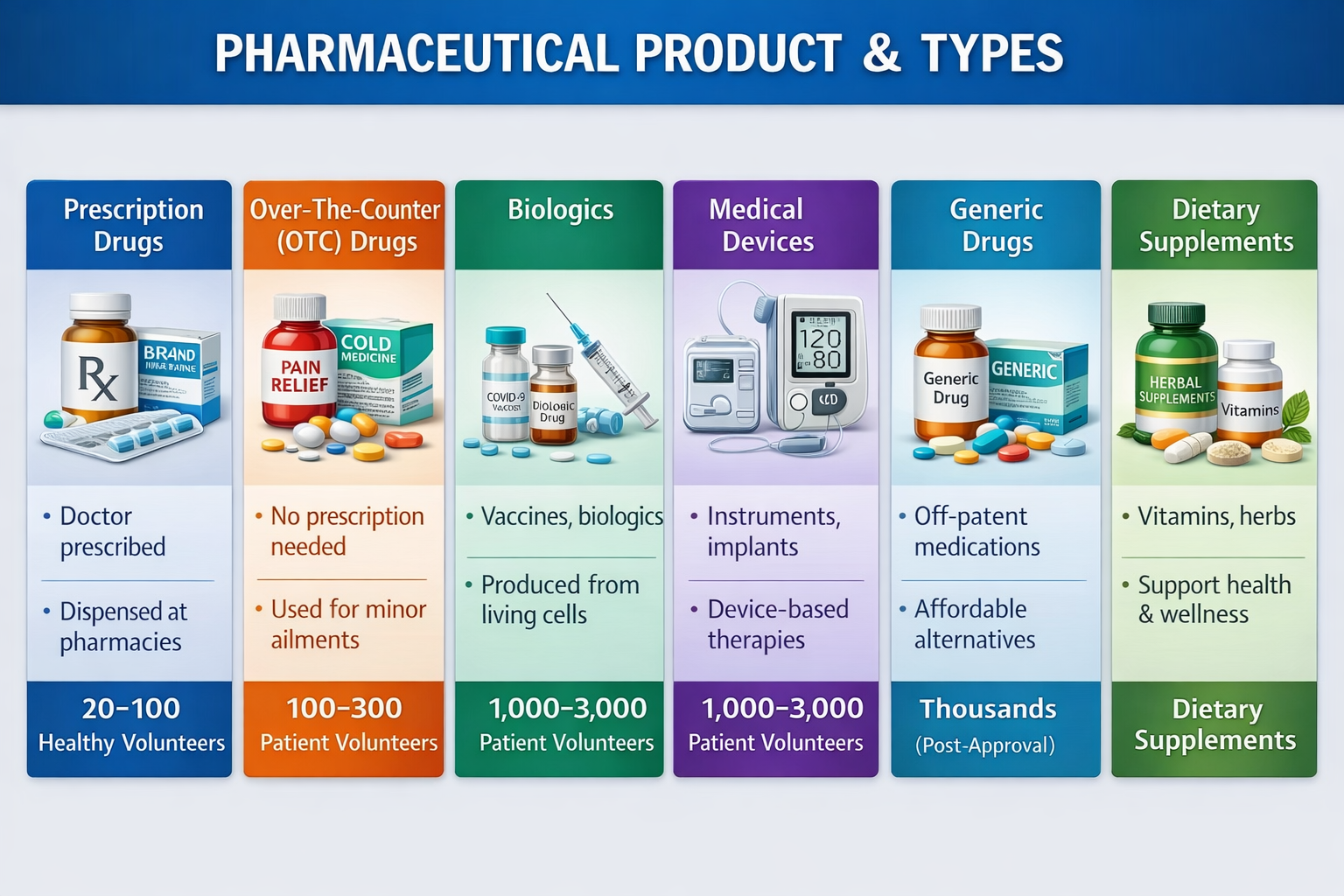
Pharmaceutical products are categorized according to their formulation, method of administration, and biological complexity. They range from conventional dosage forms such as tablets, capsules, and injectables to advanced therapies like biologics and biosimilars. Each category has its own development process, manufacturing requirements, stability considerations, and regulatory pathways. Understanding these product types is essential for professionals involved in pharmaceutical development, regulatory affairs, clinical research, manufacturing, and quality assurance.
Tablets
Tablets are solid dosage forms that contain an active pharmaceutical ingredient combined with suitable excipients and compressed into a defined shape. They are the most widely used oral dosage form because of their accuracy, stability, and ease of handling. Tablets provide precise dosing, have good shelf life, and are cost-effective to manufacture and transport. They are commonly used for large-scale production and are suitable for many types of medications.
There are several types of tablets, including immediate-release tablets that dissolve quickly after administration, extended-release or controlled-release tablets that release the drug over a longer period, enteric-coated tablets that dissolve in the intestine rather than the stomach, chewable tablets, sublingual or buccal tablets that dissolve under the tongue or in the cheek, and effervescent tablets that dissolve in water before consumption.
Tablets offer advantages such as easy administration, longer shelf life, precise dose uniformity, and suitability for mass production. However, they may not be ideal for patients who have difficulty swallowing, and they usually have a slower onset of action compared to injectable formulations. The manufacturing process for tablets typically involves granulation, compression, coating, dissolution testing, and stability studies to ensure quality and performance.
Capsules
Capsules are solid dosage forms in which the drug is enclosed within a hard or soft soluble shell, commonly made from gelatin or hydroxypropyl methylcellulose (HPMC). They are designed to improve patient acceptability and provide flexibility in formulation.
Capsules are mainly of two types. Hard gelatin capsules usually contain powders or granules, while soft gelatin capsules are used for oils or liquid formulations. Capsules help mask unpleasant tastes and often dissolve faster than tablets, leading to quicker drug release.
They offer advantages such as improved patient comfort, suitability for hygroscopic or oily drugs, and flexible formulation options. However, capsules are more sensitive to humidity and temperature, and they are generally more expensive to produce than tablets. Quality control parameters for capsules include disintegration time, uniformity of fill weight, dissolution profile, and stability testing.
Injectables
Injectables are sterile dosage forms administered directly into the body through routes such as intravenous, intramuscular, or subcutaneous injection. Because they enter the bloodstream directly, they provide a rapid onset of action and, in the case of intravenous administration, complete bioavailability.
Injectable formulations may be prepared as solutions, suspensions, emulsions, or lyophilized powders that are reconstituted before use. These products require strict manufacturing conditions, including sterility assurance, pyrogen testing, particulate matter testing, aseptic processing, and cleanroom environments.
Injectables are especially useful for emergency and critical care, for patients who cannot take oral medications, or when a rapid therapeutic effect is required. However, they involve invasive administration, carry a risk of infection, and are more expensive to manufacture and handle.
Biologics
Biologics are complex medicines derived from living organisms such as bacteria, yeast, or mammalian cells. Unlike traditional small-molecule drugs, biologics are large, complex molecules produced through advanced biotechnology processes. Examples include monoclonal antibodies, vaccines, insulin, hormones, blood products, and gene therapies.
Biologics are characterized by their large molecular size, high specificity, and targeted mechanisms of action. They are often used to treat complex or chronic conditions such as cancer, autoimmune disorders, and genetic diseases. However, they are sensitive to temperature and environmental conditions, requiring strict storage and handling procedures.
The manufacturing process for biologics involves cell line development, cell culture or fermentation, purification, formulation, and rigorous quality control testing. Because of their complexity, biologics are expensive to develop and produce. They also require extensive clinical evaluation, immunogenicity assessments, and comparability studies during regulatory review.
Biosimilars
Biosimilars are biological products that are highly similar to an already approved reference biologic. Although they are not identical to the original product due to the complexity of biological systems, they must demonstrate no clinically meaningful differences in safety, purity, or potency.
Biosimilars are typically developed after the patent of the original biologic expires. Their development focuses on proving similarity rather than repeating the entire clinical development process. This involves extensive analytical characterization, comparative non-clinical studies, pharmacokinetic and pharmacodynamic evaluations, immunogenicity testing, and confirmatory clinical trials.
The regulatory pathway for biosimilars is abbreviated compared to that of original biologics, but it still requires strict evidence of similarity. Regulatory authorities such as the U.S. Food and Drug Administration and the European Medicines Agency oversee the approval process. Biosimilars play a critical role in reducing treatment costs, increasing patient access to advanced therapies, and promoting competition in the pharmaceutical market.
Comparison of Biologics and Biosimilars
| Feature | Biologics | Biosimilars |
|---|---|---|
| Product Type | Original biological medicine | Highly similar version of an approved biologic |
| Development Approach | Full discovery and clinical development | Comparability-based development |
| Clinical Trials | Complete clinical trial program | Reduced but confirmatory clinical studies |
| Development Cost | Very high | Lower than biologics but still complex |
| Market Entry | First approved product | Enter after patent expiry of reference product |
Pharmaceutical product types therefore range from conventional solid and injectable dosage forms to highly complex biological therapies. Each category has distinct development processes, manufacturing techniques, quality controls, and regulatory requirements. A clear understanding of these differences is essential for professionals working across the pharmaceutical industry.
