
 Sign in with Google
Health Canada Overview
Overview
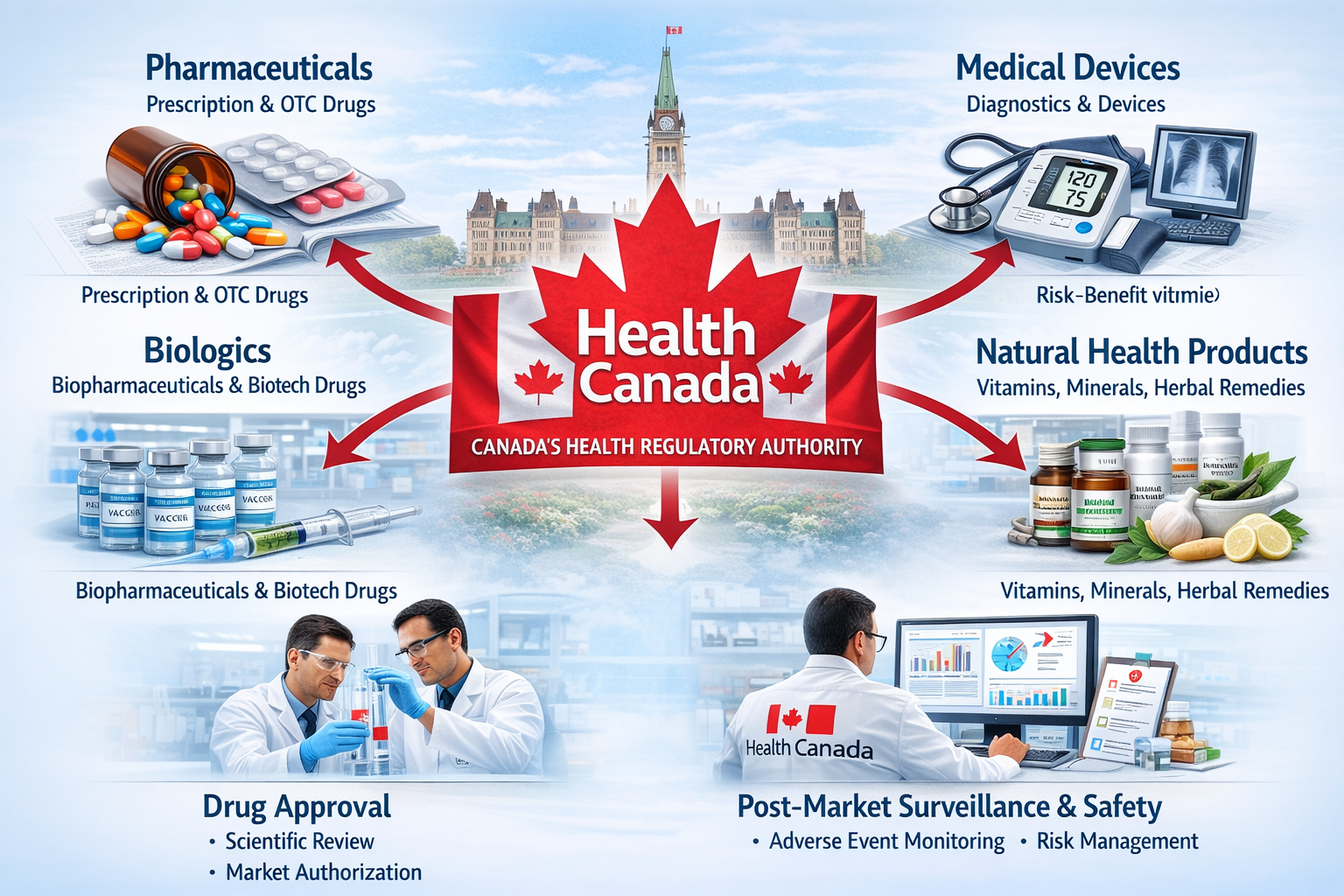
Health Canada is the federal regulatory authority responsible for protecting and promoting public health in Canada. It regulates pharmaceuticals, biologics, medical devices, and natural health products under the Food and Drugs Act and related regulations. Any medicine marketed in Canada must meet established standards of safety, efficacy, and quality before it is authorized and throughout its lifecycle.
Health Canada follows a science-based regulatory system that combines product evaluation, compliance inspections, and post-marketing safety monitoring. This approach ensures that approved medicines continue to meet regulatory requirements after they enter the market.
Organizational Structure
Health Canada operates through specialized branches responsible for scientific evaluation, compliance oversight, and pharmacovigilance activities. The main branch responsible for drug regulation is the Health Products and Food Branch, commonly known as HPFB. This branch conducts scientific assessments of drugs and biologics and grants market authorization once regulatory requirements are satisfied.
Within the Health Products and Food Branch, several directorates handle specific product categories. The Therapeutic Products Directorate regulates prescription and over-the-counter drugs and reviews New Drug Submissions and Abbreviated New Drug Submissions. The Biologic and Radiopharmaceutical Drugs Directorate regulates biologics and radiopharmaceutical products and evaluates their manufacturing processes and quality systems. The Natural and Non-prescription Health Products Directorate is responsible for natural health products, where it reviews safety, labeling, and issues product licenses.
Health Canada also has dedicated divisions for compliance and safety monitoring. The Regulatory Operations and Enforcement Branch conducts Good Manufacturing Practice inspections, oversees imports and distribution, and enforces regulatory compliance. The Marketed Health Products Directorate monitors post-marketing safety, evaluates adverse drug reactions, performs risk assessments, and communicates safety information to the public and healthcare professionals.
Drug Approval Process in Canada
All medicines must receive authorization from Health Canada before they can be marketed. The approval pathway depends on whether the product is an innovative drug or a generic version of an existing product.
For innovative medicines, companies submit a New Drug Submission. This submission includes complete data on quality, nonclinical studies, and clinical trials conducted in Phase I, II, and III. The dossier is usually submitted in the Common Technical Document or electronic CTD format.
For generic medicines, companies submit an Abbreviated New Drug Submission. Instead of full clinical trials, the applicant must demonstrate bioequivalence with a Canadian reference product. The submission must also include quality data and stability information.
Once a submission is received, Health Canada conducts an initial screening to ensure that the application is complete and properly formatted. After this administrative review, the submission moves into the scientific review phase. During this stage, experts evaluate the quality, safety, efficacy, and overall benefit–risk profile of the product. If necessary, Health Canada may request additional information or clarification from the applicant.
The standard review time for a New Drug Submission is approximately three hundred days. For products intended to treat serious or life-threatening conditions, a priority review process may be applied, which typically takes about one hundred eighty days.
If the product meets all regulatory requirements, Health Canada issues a Notice of Compliance. This document confirms that the drug is authorized for marketing in Canada. In addition, the product receives a Drug Identification Number, which is a unique eight-digit number assigned to approved drugs and is required before the product can be sold.
Post-Marketing Requirements
Regulatory responsibilities continue after a drug is approved. Companies must submit Periodic Safety Update Reports to monitor ongoing safety. They are also required to implement a Risk Management Plan that outlines strategies for minimizing risks associated with the product.
Pharmacovigilance systems must be maintained to monitor and report adverse events continuously. In addition, manufacturing facilities are subject to routine inspections to ensure compliance with Good Manufacturing Practices and other regulatory standards.
Health Canada operates through a structured, science-based regulatory framework supported by specialized evaluation, compliance, and pharmacovigilance divisions. This integrated system ensures that medicines authorized in Canada maintain high standards of safety, quality, and therapeutic effectiveness throughout their lifecycle.
