
 Sign in with Google
Supplements
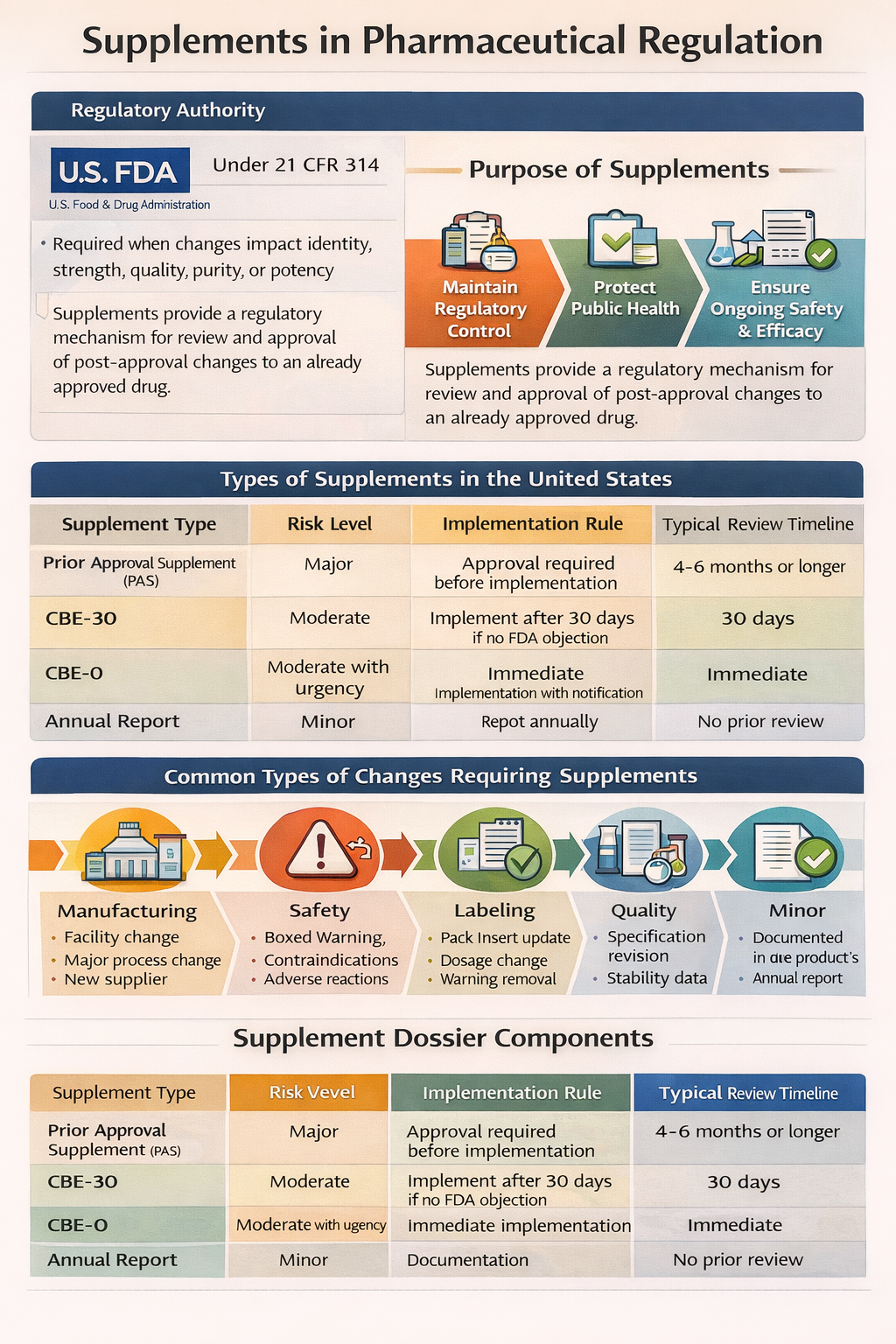
Supplements are post-approval regulatory submissions made to update or modify an already approved application. They are commonly used in the United States regulatory system when changes are made to an approved NDA, ANDA, or BLA. A supplement ensures that any modification to quality, safety, efficacy, labeling, or manufacturing is reviewed and authorized when required.
Regulatory Authority
In the United States, supplements are submitted to the U.S. Food and Drug Administration under 21 CFR 314. Supplements are mandatory when changes have the potential to impact the identity, strength, quality, purity, or potency of the drug product.
Purpose of Supplements
A supplement maintains regulatory control after product approval. Once a drug is approved, it cannot be changed freely. Any significant modification requires formal notification or approval depending on risk level. Supplements protect public health by ensuring that post-approval changes do not compromise product safety or effectiveness.
Types of Supplements in the United States
| Supplement Type | Risk Level | Implementation Rule | Typical Review Timeline |
|---|---|---|---|
| Prior Approval Supplement (PAS) | Major | Approval required before implementation | 4–6 months or longer |
| CBE-30 | Moderate | Implement after 30 days if no FDA objection | 30 days |
| CBE-0 | Moderate with urgency | Immediate implementation with notification | Immediate |
| Annual Report | Minor | Report annually | No prior review |
Prior Approval Supplement
This is required for major changes with substantial potential to adversely affect product quality or safety. Examples include addition of a new manufacturing site, major process changes, new indication, or significant labeling updates. The change cannot be implemented until FDA approval is granted.
CBE-30
Changes Being Effected in 30 days applies to moderate changes. The company may implement the change 30 days after FDA receives the supplement, unless the agency objects.
CBE-0
For certain safety-related labeling updates, especially those strengthening warnings or precautions, companies may implement the change immediately upon submission.
Annual Reportable Changes
Minor changes that have minimal potential impact can be documented in the product’s annual report.
Labeling Supplements
Labeling changes often require supplement submission. Safety updates, addition of boxed warnings, new contraindications, dosage revisions, or promotional compliance corrections may require PAS or CBE categories depending on impact.
Supplement Dossier Components
A typical supplement includes:
Updated application form
Detailed description of the proposed change
Scientific justification
Comparative data or validation reports
Revised labeling text if applicable
Risk assessment
Relationship with Variations
In the European Union system managed by the European Medicines Agency, similar post-approval changes are called variations. While terminology differs, the regulatory principle remains risk-based classification.
Inspection Perspective
During inspections, regulators verify whether changes were correctly classified, submitted in the correct category, and implemented only after appropriate approval. Failure to submit a required supplement can result in regulatory action, including warning letters or product recalls.
Lifecycle Impact
Supplements are part of lifecycle management. As new data emerges, manufacturing evolves, or safety information updates, supplements ensure continuous regulatory oversight without requiring a completely new application.
Supplements therefore function as a structured regulatory control mechanism that preserves product quality, safety, and efficacy after initial approval, ensuring ongoing compliance throughout the product lifecycle.
