
 Sign in with Google
Lifecycle Operators
Overview
Lifecycle Operators are predefined actions used in the electronic Common Technical Document (eCTD) to manage document updates throughout the regulatory lifecycle of a pharmaceutical product. They define how a newly submitted document relates to a previously submitted document within the same eCTD sequence.
Lifecycle operators are part of the XML backbone structure and ensure proper version control, traceability, and regulatory transparency. They allow regulatory authorities to clearly identify whether a document is new, modified, supplemented, or removed.
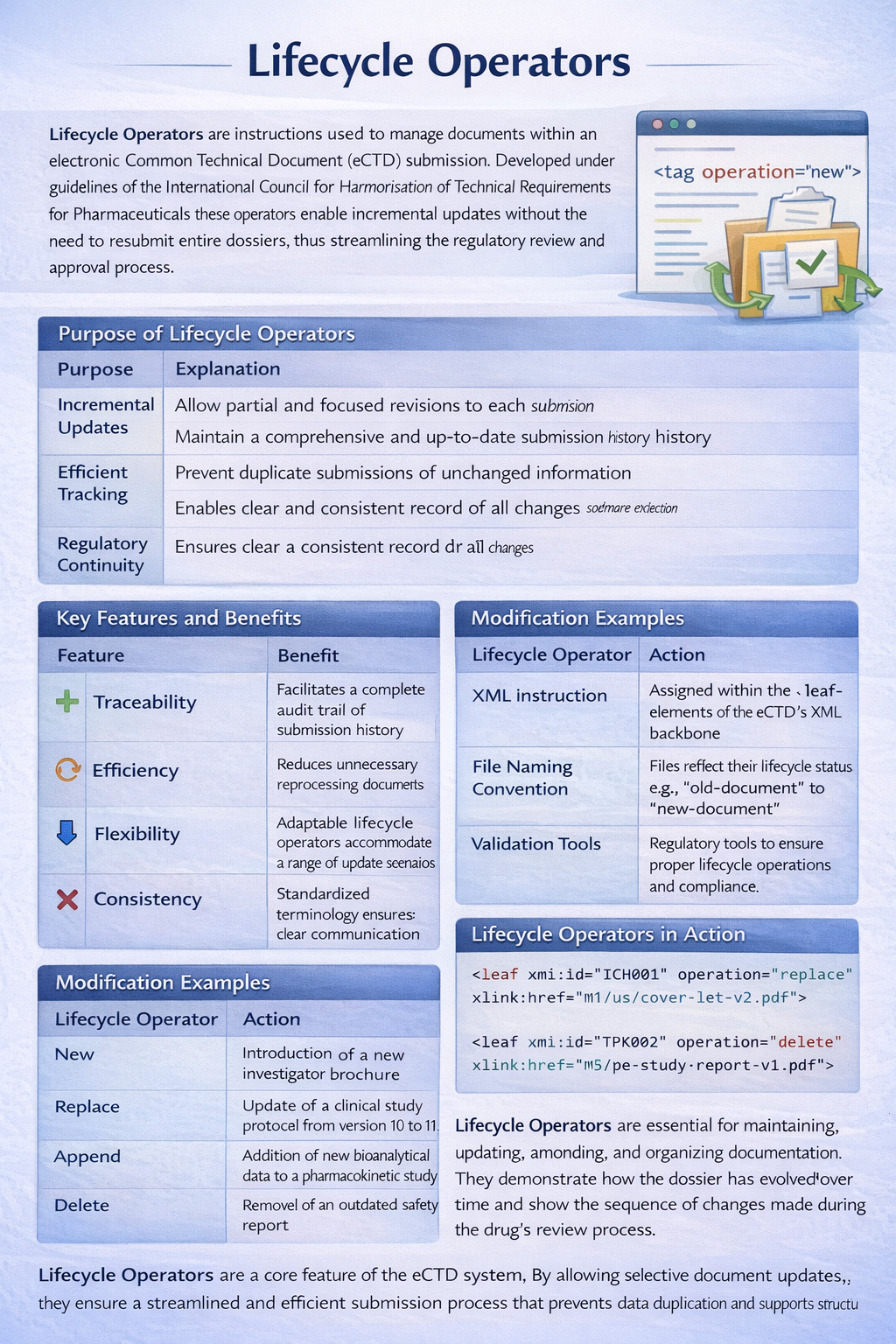
Purpose of Lifecycle Operators
| Purpose | Explanation |
|---|---|
| Version Control | Maintains structured document revision history |
| Change Identification | Clearly indicates the nature of document updates |
| Regulatory Transparency | Provides a clear audit trail |
| Efficient Review | Helps reviewers focus on modified content |
| Lifecycle Management | Supports structured submission tracking |
Primary Lifecycle Operators in eCTD
Under the harmonized framework developed by the International Council for Harmonisation of Technical Requirements for Pharmaceuticals for Human Use, the following lifecycle operators are commonly used:
| Operator | Definition | Practical Application |
|---|---|---|
| New | Introduces a document for the first time | Initial submission of a study report |
| Replace | Substitutes a previously submitted document | Updating stability data with revised values |
| Append | Adds additional information without replacing the original document | Submitting supplementary data |
| Delete | Removes a previously submitted document from the current view | Withdrawal of an incorrect document |
How Lifecycle Operators Work in Sequences
Each eCTD submission is assigned a unique sequence number. Within that sequence, lifecycle operators specify the relationship between current and previous submissions.
| Sequence Example | Action Taken | Lifecycle Operator Used |
|---|---|---|
| 0000 | Initial submission of Quality Overall Summary | New |
| 0001 | Updated Quality Overall Summary submitted | Replace |
| 0002 | Additional stability study added | Append |
| 0003 | Obsolete document removed | Delete |
Regulatory Importance
Regulatory agencies such as the U.S. Food and Drug Administration and the European Medicines Agency rely on lifecycle operators to track changes efficiently. Without lifecycle operators, reviewers would need to manually compare entire submissions, increasing complexity and review time.
Technical Integration
Lifecycle operators are coded within the XML backbone file. Each document (leaf element) contains metadata indicating:
• The lifecycle operation
• Reference to the previously submitted document (if applicable)
• The sequence in which the change is being made
This structured system ensures proper audit trails and compliance with regional eCTD validation criteria.
Conclusion
Lifecycle Operators are a critical component of eCTD lifecycle management. They enable precise document control, efficient regulatory review, systematic version tracking, and transparent communication between pharmaceutical companies and regulatory authorities.
