 Sign in with Google
Electronic Records and Signatures (21 CFR Part 11)
21 CFR Part 11 – Electronic Records and Electronic Signatures
21 CFR Part 11 is a regulation issued by the U.S. Food and Drug Administration that governs electronic records and electronic signatures in FDA-regulated industries. It defines the criteria under which electronic records and electronic signatures are considered trustworthy, reliable, and equivalent to paper records and handwritten signatures. While Part 11 does not mandate the use of electronic systems, it prescribes the controls required when electronic records replace paper documentation. Understanding Part 11 is essential for professionals working in pharmaceutical manufacturing, biotechnology, medical devices, clinical research, quality assurance, IT validation, and regulatory affairs. Mastery of these requirements ensures compliance, supports data integrity, and strengthens inspection readiness.
Purpose and Scope
The primary objective of 21 CFR Part 11 is to maintain data integrity and system security in electronic environments. It applies to all FDA-regulated records that are created, modified, maintained, archived, retrieved, or transmitted electronically. Electronic records covered under Part 11 include batch manufacturing records, laboratory analytical data generated by chromatography software, clinical trial data captured in electronic data capture systems, deviation and CAPA records stored in quality management systems, and training or compliance records maintained in learning management systems. Compliance is required if an electronic record fulfills a regulatory requirement under FDA rules.
| Type of Electronic Record | Typical System/Application | Compliance Implication |
|---|---|---|
| Batch Manufacturing Records | Manufacturing Execution Systems (MES) | Must ensure audit trail and access control |
| Laboratory Analytical Data | Chromatography, LIMS | Must maintain accurate, attributed, and contemporaneous entries |
| Clinical Trial Data | Electronic Data Capture (EDC) | Records must be complete, legible, and secure |
| Deviation and CAPA Records | Electronic Quality Management System (eQMS) | Must allow authorized approval and review |
| Training and Compliance Records | Learning Management System (LMS) | Must demonstrate user authentication and retention |
Key Definitions
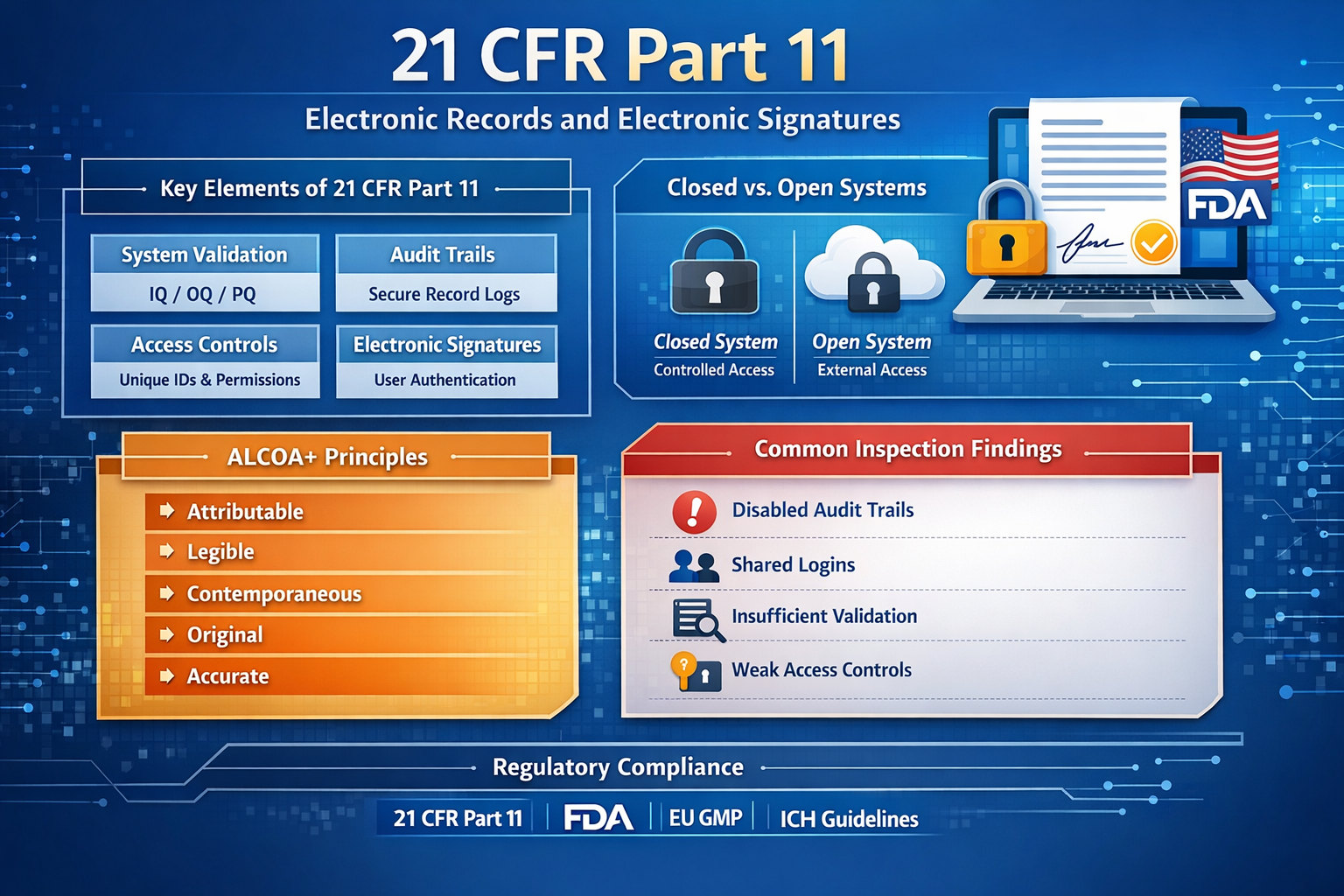
Part 11 compliance requires understanding key terms such as electronic record, electronic signature, closed system, and open system. An electronic record is a combination of text, graphics, or data maintained digitally and must be reliable and accurate as a paper record. An electronic signature is a computer-generated identifier that authenticates an individual’s approval or authorship and is legally equivalent to a handwritten signature. A closed system restricts access to authorized personnel responsible for the record, while an open system is not fully controlled, such as externally hosted cloud platforms, and requires additional security measures.
| Term | Definition | Regulatory Significance |
|---|---|---|
| Electronic Record | Digital text, graphics, or data maintained electronically | Must ensure reliability, accuracy, and traceability |
| Electronic Signature | Digital authentication of approval or authorship | Legally equivalent to handwritten signature, must be unique |
| Closed System | Fully controlled access by organization | Standard Part 11 compliance applies |
| Open System | Access partially uncontrolled | Requires enhanced security and verification |
Core Compliance Requirements
Compliance with Part 11 requires implementation of both technical and procedural controls. Computerized systems must be validated to confirm that they operate accurately, reliably, and consistently. Validation typically includes user requirement specification, risk assessment, installation qualification, operational qualification, and performance qualification. Audit trails must record all operator entries, modifications, and deletions, with secure time-stamped records that are regularly reviewed. Access to systems must be restricted to authorized personnel using unique usernames and role-based permissions. Operational system checks ensure that workflow steps follow a controlled sequence, authority checks restrict actions to designated personnel, and device checks prevent unauthorized use of input devices.
| Control Area | Description | Industry Application |
|---|---|---|
| System Validation | Confirms that computerized systems function according to intended use | MES, LIMS, ERP, EDMS |
| Audit Trails | Secure, computer-generated logs of all record actions | Supports data integrity and inspection readiness |
| Access Controls | Restrict system access to authorized personnel | Enforces role-based permissions, prevents shared accounts |
| Operational System Checks | Ensures permitted sequence of operations | Maintains process control and compliance |
| Authority Checks | Limits approval and modification to authorized users | Critical for batch records and CAPA approvals |
| Device Checks | Ensures input devices function correctly | Prevents erroneous or unauthorized data entry |
Electronic Signature Requirements
Electronic signatures under Part 11 must be unique to each individual, verified before assignment, and certified to the FDA for legal intent. They must include at least two distinct identification components, typically a username and password, and capture the printed name of the signer, date and time of the signature, and the meaning of the signature, such as review, approval, or authorship. Electronic signatures are critical for batch approvals, validation reports, and quality document sign-offs.
Practical Industry Implementation
In real-world settings, Part 11 compliance is achieved through collaboration between Quality Assurance, IT, Validation, and Regulatory Affairs teams. Systems requiring compliance include LIMS, MES, ERP, EDMS, and eQMS. Practical measures include performing gap assessments, developing Part 11 SOPs, conducting periodic audit trail reviews, reviewing access rights, enforcing password policies, validating backup and disaster recovery systems, and performing periodic system revalidation.
| System Type | Part 11 Consideration | Practical Measure |
|---|---|---|
| LIMS | Audit trail, data integrity | Periodic review and validation |
| MES | Access controls, operational checks | Role-based permissions and system validation |
| ERP | Authority checks, system sequencing | Ensure approval workflows and access restrictions |
| EDMS | Electronic signatures, audit trails | Validation and review for document approvals |
| eQMS | Data review, CAPA records | Trackable and attributable records |
Common Inspection Findings
During regulatory inspections, deficiencies frequently include disabled or incomplete audit trails, shared login credentials, insufficient system validation, inadequate access control reviews, and unreviewed electronic records. Awareness of these issues allows professionals to implement proactive corrective measures to prevent regulatory enforcement actions.
| Finding | Compliance Risk |
|---|---|
| Disabled audit trails | Data cannot be traced or verified |
| Shared login credentials | Attribution of actions is compromised |
| Insufficient system validation | System reliability cannot be assured |
| Inadequate access reviews | Unauthorized access may alter data |
| Unreviewed electronic records | Regulatory procedural non-compliance |
Risk-Based Approach
Modern regulatory guidance emphasizes a risk-based approach to Part 11 compliance. Systems that impact product quality, patient safety, or regulatory decision-making require stricter controls. Risk assessment involves evaluating product impact, data criticality, system complexity, level of automation, and third-party integration. Part 11 compliance is often integrated with broader data integrity frameworks, supporting ALCOA+ principles.
Relationship with Data Integrity
Part 11 reinforces ALCOA+ principles, ensuring records are attributable, legible, contemporaneous, original, accurate, complete, consistent, enduring, and available. Audit trails support traceability, validation ensures accuracy, and access controls prevent unauthorized manipulation, strengthening overall quality systems and inspection readiness.
Career Relevance
Professionals in QA, IT validation, and regulatory affairs must understand Part 11 thoroughly. They should be able to explain system validation, audit trails, electronic signatures, and closed versus open systems. Additionally, they should recognize common inspection findings, implement compliance measures, and integrate Part 11 with data integrity and quality systems. Mastery of these topics demonstrates regulatory awareness and industry readiness for entry-level and professional roles.
