
 Sign in with Google
Module 4 Non-Clinical Reports
Introduction
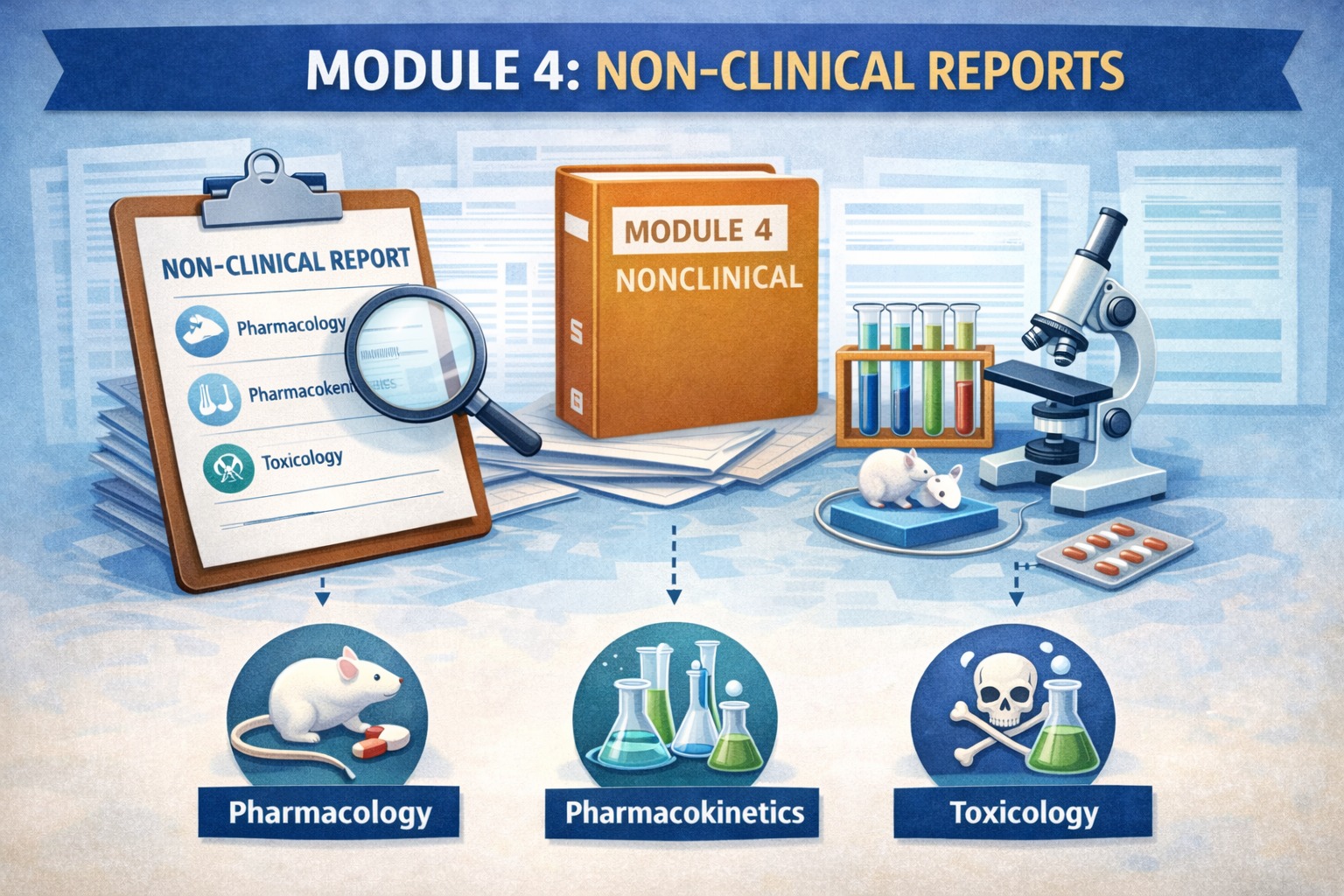
Module 4 of the Common Technical Document (CTD) contains nonclinical study reports, which provide evidence of the safety profile of the investigational or marketed product. This module is harmonized under ICH guidelines and is essential for demonstrating that the product can be safely administered to humans. Nonclinical studies include pharmacology, pharmacokinetics, and toxicology investigations performed in vitro and in vivo. Module 4 bridges the gap between preclinical research and clinical trials, offering regulators scientific justification for initiating human studies or for continued marketing. For Regulatory Affairs professionals, preparing Module 4 requires coordination with nonclinical scientists, toxicologists, pharmacologists, and regulatory specialists to ensure accurate, complete, and well-organized documentation.
Purpose of Module 4
The primary purpose of Module 4 is to provide regulatory authorities with detailed nonclinical data supporting the safety of the product. This includes demonstrating the absence of significant toxic effects, identifying potential target organs for toxicity, evaluating pharmacokinetic behavior, and establishing safe starting doses for clinical trials. Module 4 also helps regulators assess risk-benefit profiles, supports labeling recommendations, and provides critical information for post-marketing safety monitoring. Proper preparation of Module 4 ensures that regulatory authorities can make informed decisions regarding clinical trial approvals, marketing authorizations, and risk mitigation strategies.
Content of Module 4
| Section | Description |
|---|---|
| Pharmacology | Includes studies on the mechanism of action, efficacy, receptor binding, and other pharmacodynamic effects of the product. Primary pharmacodynamics, secondary pharmacodynamics, and safety pharmacology are included to evaluate the intended effect and off-target effects. |
| Pharmacokinetics (PK) | Covers absorption, distribution, metabolism, and excretion (ADME) studies in animal models. Includes bioavailability, tissue distribution, clearance, half-life, and potential drug-drug interactions. PK data support dose selection and safety evaluations in humans. |
| Toxicology | Provides acute, sub-chronic, chronic, reproductive, genotoxicity, carcinogenicity, and local tolerance studies. These studies identify toxicological endpoints, target organs, and potential risks to humans. Data are presented in a structured format with detailed study protocols and results. |
| Study Reports | Complete, GLP-compliant reports for each nonclinical study. Includes objectives, methodology, results, discussion, and conclusions. Reports should be cross-referenced and consistent with summaries in Module 2. |
| Tabular and Narrative Summaries | Summarizes nonclinical studies in tables and narratives, highlighting key findings, no observed adverse effect levels (NOAELs), and safety margins. Enhances regulatory understanding of critical safety data. |
| Integrated Safety Assessment | Combines pharmacology, PK, and toxicology data to provide an overall evaluation of product safety. Supports risk assessment and justification for clinical dosing. |
Practical Application in Regulatory Submissions
Module 4 plays a critical role in regulatory decision-making. Regulatory authorities use nonclinical data to evaluate potential risks, approve clinical trial protocols, and provide labeling recommendations. Regulatory Affairs professionals must ensure that Module 4 is complete, accurate, and consistent with other CTD modules, especially Module 2 summaries and Module 5 clinical data. Preparation requires collaboration with nonclinical teams to compile GLP-compliant reports, cross-check data, and ensure proper tabular and narrative presentation. Module 4 also supports safety updates, post-marketing risk management, and responses to regulatory queries.
Common Challenges and Best Practices
Challenges in Module 4 preparation include managing large volumes of technical data, ensuring GLP compliance, maintaining consistency with Module 2 summaries, and clearly presenting complex study results. Best practices include using standardized templates, integrating study data into tabular and graphical formats, performing thorough cross-functional reviews, and maintaining detailed study references. Clear cross-referencing between Module 2 summaries and Module 4 reports is critical to minimize regulatory queries. Understanding ICH safety guidelines (S-series), GLP requirements, and regional nonclinical submission standards ensures that Module 4 meets regulatory expectations.
Conclusion
Module 4 is a crucial component of the CTD that provides comprehensive nonclinical safety data for regulatory evaluation. It supports the safe progression of a product from preclinical studies to clinical trials and informs regulatory decisions regarding human safety. Mastery of Module 4 preparation demonstrates the ability to compile, organize, and present complex scientific data accurately and efficiently. For Regulatory Affairs professionals, understanding Module 4 ensures compliance with GLP, harmonized reporting, and alignment with global regulatory expectations. Properly prepared nonclinical reports reduce regulatory delays, strengthen the risk-benefit assessment, and enhance overall submission quality, making Module 4 an essential skill for job-ready candidates in regulatory submissions and global product approvals.
