
 Sign in with Google
Module 5 Clinical Reports
Introduction
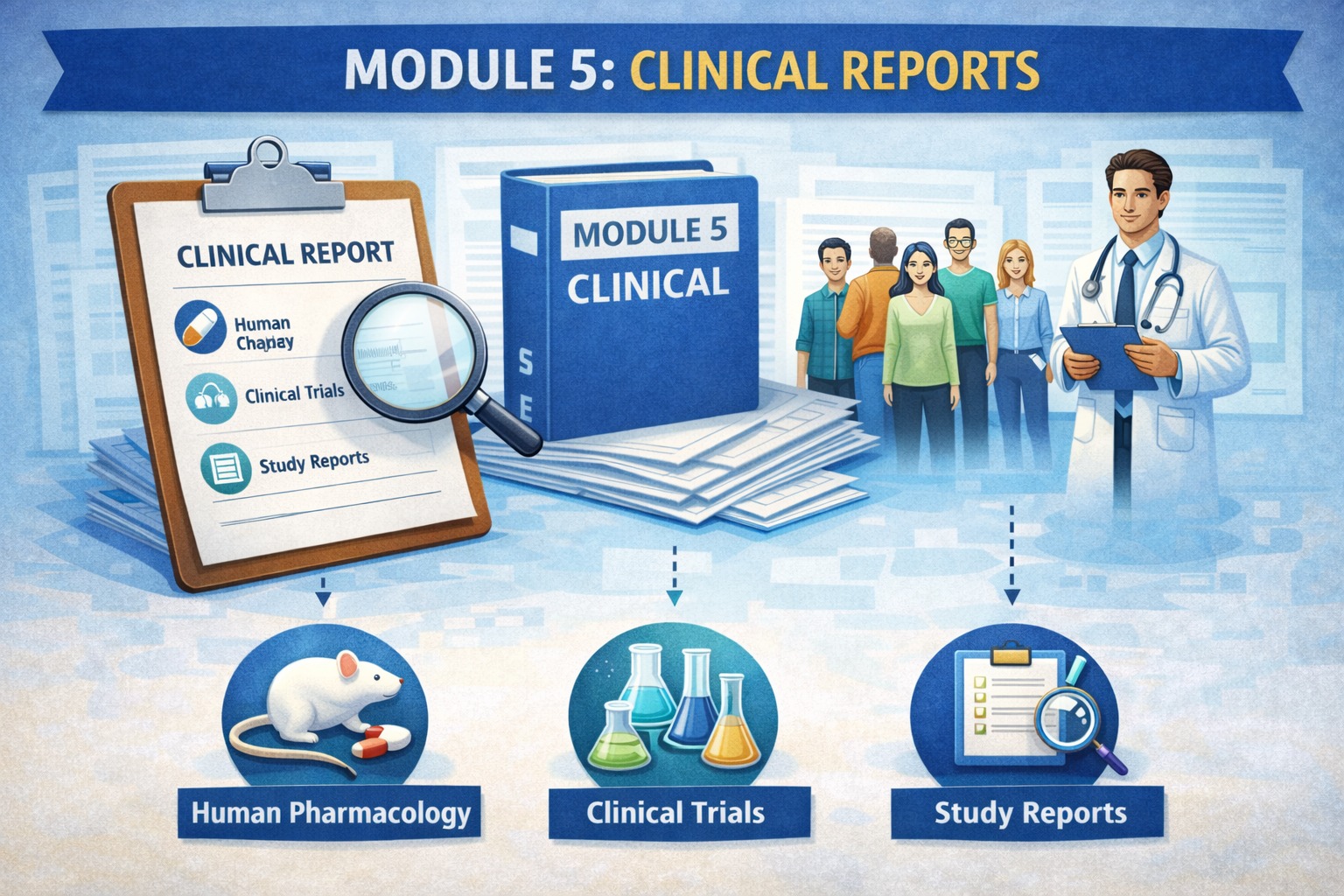
Module 5 of the Common Technical Document (CTD) contains the clinical study reports for a pharmaceutical or biologic product. This module is fully harmonized under ICH guidelines and serves as the primary source of evidence for a product’s safety and efficacy in humans. It provides regulatory authorities with comprehensive data from Phase I through Phase IV studies, including controlled, uncontrolled, and post-marketing investigations. Module 5 bridges nonclinical data from Module 4 and quality data from Module 3 to establish a robust risk-benefit profile. For Regulatory Affairs professionals, accurate preparation of Module 5 requires collaboration with clinical operations, biostatistics, medical writing, and quality teams, as well as deep understanding of Good Clinical Practice (GCP), ICH Efficacy Guidelines (E-series), and regional requirements.
Purpose of Module 5
The primary purpose of Module 5 is to provide regulators with detailed clinical evidence supporting the product’s safety, efficacy, and overall risk-benefit profile. Regulatory authorities use this module to evaluate trial design, patient population, statistical analyses, adverse events, and therapeutic outcomes. Module 5 is essential not only for initial marketing approval but also for lifecycle management, including additional indications, labeling updates, and post-marketing surveillance. For Regulatory Affairs professionals, a well-prepared Module 5 ensures regulators can efficiently assess the clinical program, reduces the likelihood of queries, and accelerates approval timelines.
Content of Module 5
| Section | Description |
|---|---|
| Study Reports | Full GCP-compliant reports of all clinical trials, including Phase I (safety and pharmacokinetics), Phase II (dose-finding and preliminary efficacy), Phase III (confirmatory efficacy and safety), and Phase IV (post-marketing) studies. Each report includes objectives, methodology, patient demographics, statistical analysis, results, discussion, and conclusions. |
| Integrated Efficacy Summaries | Combines results from multiple trials to present overall treatment effect, dose-response relationships, and therapeutic outcomes. May include pooled analyses and subgroup evaluations to support product benefit claims. |
| Integrated Safety Summaries | Consolidates safety data across studies, highlighting adverse events, serious adverse events, laboratory abnormalities, and other safety endpoints. Includes narratives, tables, and graphical presentations. |
| Statistical Analysis | Detailed description of statistical methods, including randomization, blinding, sample size determination, handling of missing data, and sensitivity analyses. Supports validity and reproducibility of results. |
| Clinical Risk-Benefit Assessment | Integrates efficacy, safety, and nonclinical data to provide an overall evaluation of the product’s risk-benefit profile. Supports labeling recommendations, dosing guidelines, and regulatory decision-making. |
| Special Population Data | Clinical data for pediatric, geriatric, or other special populations, as applicable, including pharmacokinetics, safety, and efficacy considerations. |
| Post-Marketing Experience | Real-world evidence from marketed products, including adverse event reporting, risk management updates, and ongoing safety monitoring. Supports lifecycle management and regulatory compliance. |
Practical Application in Regulatory Submissions
Module 5 is the cornerstone of regulatory clinical evaluation. Regulatory Affairs professionals must ensure that all clinical data are accurate, complete, and consistent with Module 2 summaries and Module 4 nonclinical findings. Preparation involves reviewing clinical trial reports, integrating results across studies, validating statistical analyses, and ensuring adherence to GCP standards. Properly structured Module 5 submissions facilitate regulator understanding, minimize review time, and provide a foundation for labeling, post-marketing commitments, and regulatory discussions. Clear use of tables, figures, and concise narratives enhances readability and demonstrates professional presentation of complex clinical information.
Common Challenges and Best Practices
Key challenges in Module 5 include managing large volumes of complex clinical data, ensuring consistency with summaries in Module 2, and presenting safety and efficacy data clearly. Best practices include using standardized templates for clinical study reports, integrating efficacy and safety data in tabular and graphical formats, cross-referencing studies, and performing multi-level internal reviews. Regulatory Affairs professionals should stay updated on regional guidance (FDA, EMA, Health Canada, CDSCO) for clinical submissions, including electronic submission requirements (eCTD). Collaboration with clinical, statistical, and quality teams is essential for a high-quality, query-free submission.
Conclusion
Module 5 is the most critical module of the CTD, providing comprehensive clinical evidence required for regulatory approval. Mastery of Module 5 preparation equips Regulatory Affairs professionals to compile, organize, and present clinical data effectively, supporting safe and effective product use. Properly prepared clinical study reports reduce regulatory queries, strengthen the risk-benefit assessment, and facilitate lifecycle management. Understanding Module 5, along with Modules 1 through 4, ensures job-ready professionals can manage global submissions, maintain compliance with ICH and regional regulations, and contribute to successful pharmaceutical product approvals worldwide.
