
 Sign in with Google
EMA Structure and Centralized Procedured
Overview
The European Medicines Agency (EMA) is responsible for the scientific evaluation, supervision, and safety monitoring of medicines within the European Union. It operates through a network-based system that includes EMA scientific committees and the National Competent Authorities of EU Member States. This coordinated approach ensures harmonized regulatory standards and consistent oversight across Europe.
The EMA does not function as a single centralized regulator. Instead, it works in collaboration with national agencies, combining expertise from different countries to evaluate medicines and monitor their safety throughout their lifecycle.
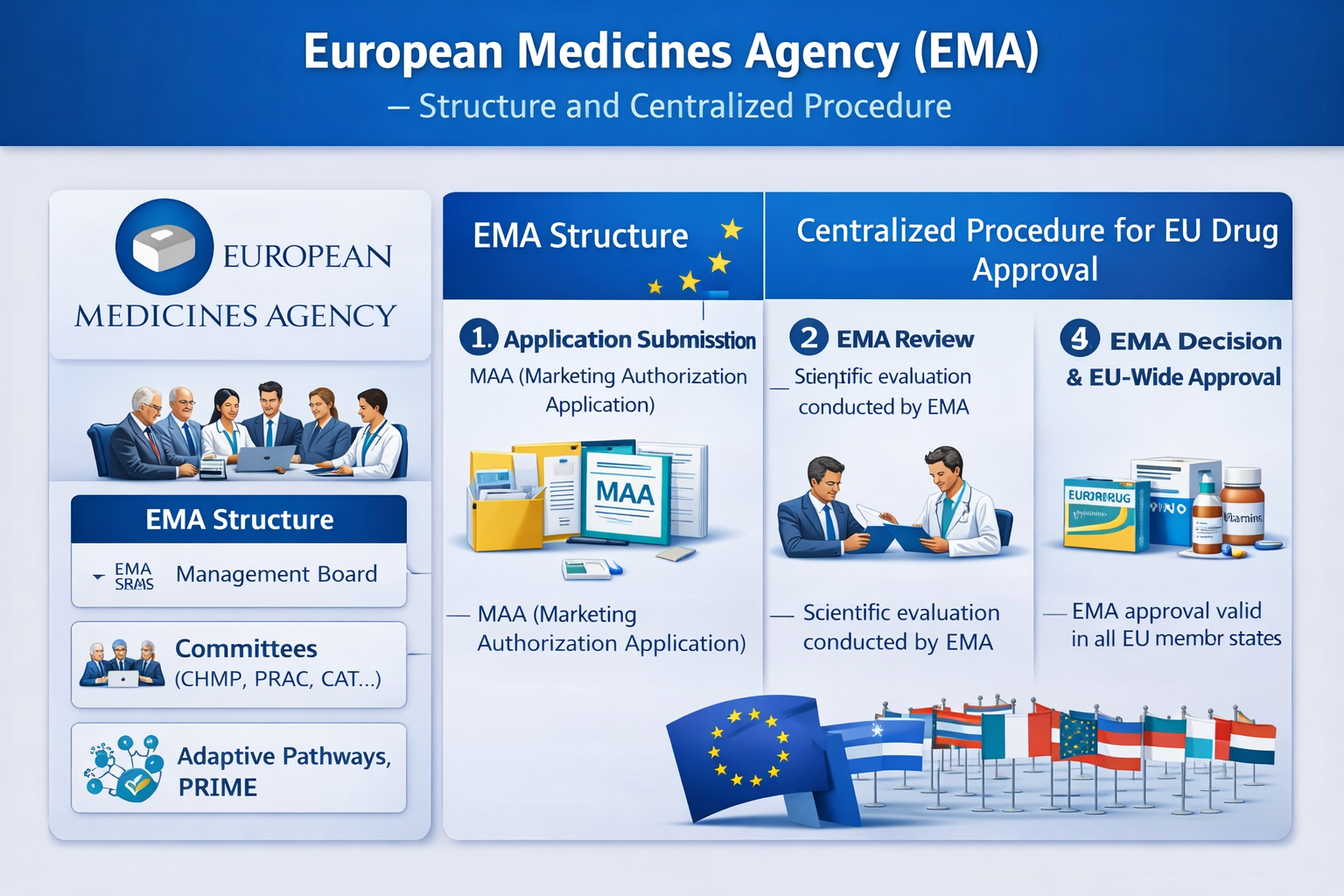
The EMA is governed by a management structure that oversees administrative operations and strategic direction. At the top is the Executive Director, who leads the agency and is responsible for daily operations and implementation of regulatory strategies. Supporting this role is the Management Board, which supervises performance, approves budgets, and sets work programs. The board includes representatives from EU Member States, the European Commission, and the European Parliament.
The EMA Secretariat provides scientific, technical, and administrative support. It coordinates activities between committees, national authorities, and other stakeholders to ensure efficient regulatory processes.
Scientific Committees
The scientific committees form the core of the EMA’s evaluation system. These committees consist of experts from EU Member States and are responsible for reviewing medicines and making scientific recommendations.
| Committee | Primary Function |
|---|---|
| Committee for Medicinal Products for Human Use (CHMP) | Evaluates human medicines and reviews Marketing Authorization Applications |
| Pharmacovigilance Risk Assessment Committee (PRAC) | Monitors post-marketing safety and evaluates adverse reactions |
| Committee for Advanced Therapies (CAT) | Assesses gene, cell, and tissue-engineered therapies |
| Committee for Medicinal Products for Veterinary Use (CVMP) | Evaluates veterinary medicines |
| Pediatric Committee (PDCO) | Reviews Pediatric Investigation Plans |
| Committee for Orphan Medicinal Products (COMP) | Evaluates orphan designation for rare disease treatments |
Working parties and scientific advisory groups support these committees by providing specialized expertise during complex evaluations.
Coordination with National Authorities
The EMA works closely with National Competent Authorities across EU Member States. These national agencies participate in scientific assessments, inspections, and safety monitoring. This network-based model ensures consistent regulatory decisions and harmonized standards throughout the European Union.
Centralized Procedure
The Centralized Procedure allows a company to obtain a single marketing authorization that is valid across all EU Member States. Instead of applying separately in each country, the applicant submits one application to the EMA. After scientific evaluation, a single decision is issued that applies throughout the EU.
| Feature | Description |
|---|---|
| Single MAA Submission | One application submitted to EMA |
| Scientific Review | Evaluation conducted by CHMP |
| Single Scientific Opinion | Unified recommendation issued |
| European Commission Decision | Final legally binding authorization |
| EU-Wide Validity | Approval applicable in all EU countries |
Steps in the Centralized Procedure
| Step | Process Description |
|---|---|
| Step 1 – Submission | Applicant submits MAA in eCTD format with CTD Modules 1–5 |
| Step 2 – Validation | EMA checks dossier completeness and eligibility |
| Step 3 – Scientific Evaluation | Rapporteur and Co-Rapporteur assess the application; questions may be issued and clock-stop applied |
| Step 4 – CHMP Opinion | CHMP adopts a positive or negative scientific opinion |
| Step 5 – European Commission Decision | Legally binding EU-wide marketing authorization granted |
Products Subject to the Mandatory Centralized Procedure
| Category | Examples |
|---|---|
| Biotechnology-Derived Medicines | Recombinant proteins, monoclonal antibodies |
| Advanced Therapy Medicinal Products | Gene and cell-based therapies |
| Orphan Medicines | Treatments for rare diseases |
| Specific Therapeutic Areas | Cancer, HIV/AIDS, diabetes, neurodegenerative disorders |
Advantages of the Centralized Procedure
| Advantage | Regulatory Benefit |
|---|---|
| Single EU Approval | Access to all EU Member States with one authorization |
| Harmonized Labeling | Uniform product information across the EU |
| Coordinated Pharmacovigilance | Centralized safety monitoring |
| Streamlined Review | Efficient and structured evaluation process |
The centralized procedure provides a unified pathway for marketing authorization in Europe, improving efficiency, consistency, and access to medicines across all EU Member States.
