 Sign in with Google
Submission Sequences
What Is Submission Sequences?
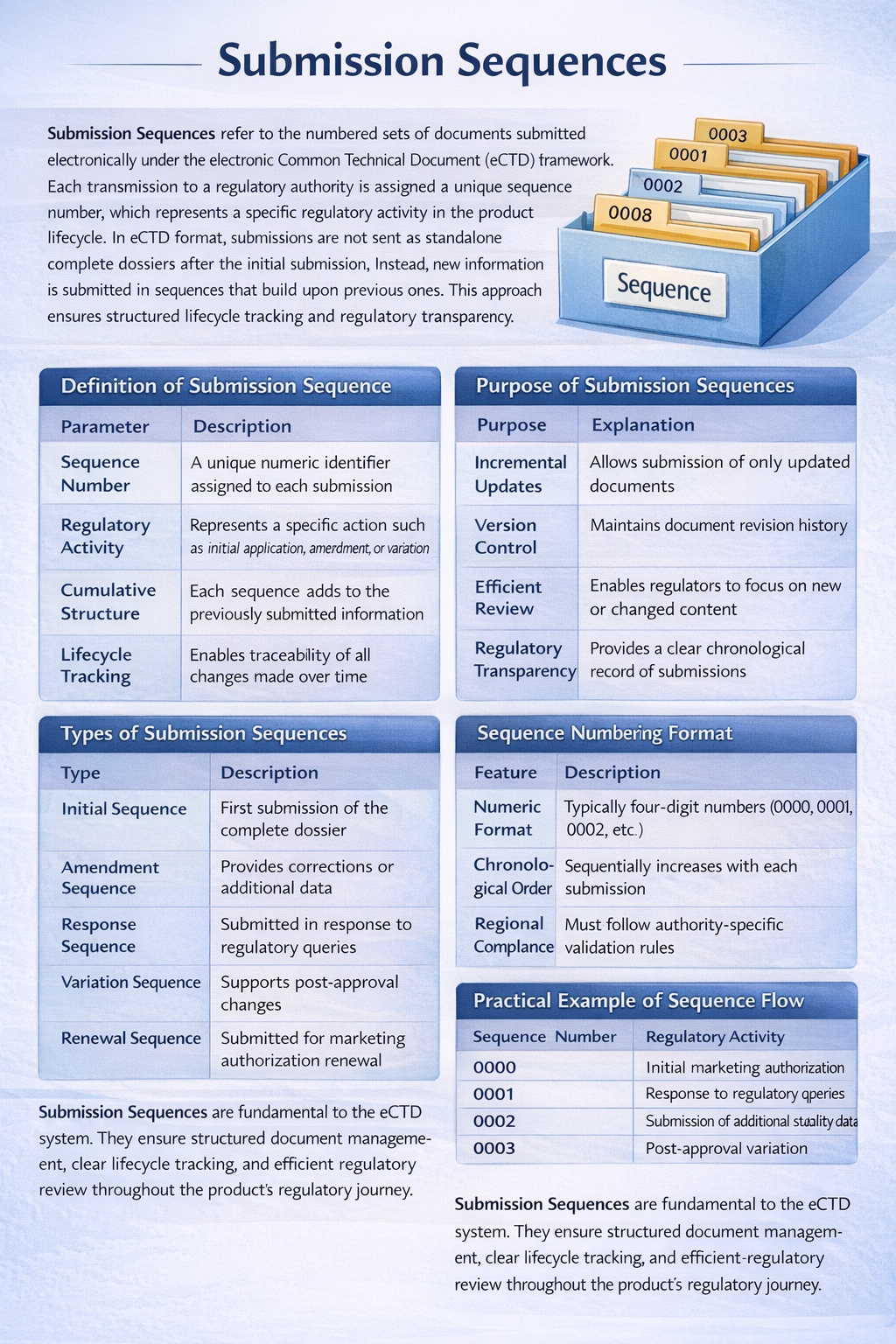
Submission Sequences refer to the numbered sets of documents submitted electronically under the electronic Common Technical Document (eCTD) framework. Each transmission to a regulatory authority is assigned a unique sequence number, which represents a specific regulatory activity in the product lifecycle.
In eCTD format, submissions are not sent as standalone complete dossiers after the initial submission. Instead, new information is submitted in sequences that build upon previous ones. This approach ensures structured lifecycle tracking and regulatory transparency.
Definition of Submission Sequence
| Parameter | Description |
|---|---|
| Sequence Number | A unique numeric identifier assigned to each submission |
| Regulatory Activity | Represents a specific action such as initial application, amendment, or variation |
| Cumulative Structure | Each sequence adds to the previously submitted information |
| Lifecycle Tracking | Enables traceability of all changes made over time |
Purpose of Submission Sequences
| Purpose | Explanation |
|---|---|
| Incremental Updates | Allows submission of only updated documents |
| Version Control | Maintains document revision history |
| Efficient Review | Enables regulators to focus on new or changed content |
| Regulatory Transparency | Provides a clear chronological record of submissions |
Types of Submission Sequences
| Type | Description |
|---|---|
| Initial Sequence | First submission of the complete dossier |
| Amendment Sequence | Provides corrections or additional data |
| Response Sequence | Submitted in response to regulatory queries |
| Variation Sequence | Supports post-approval changes |
| Renewal Sequence | Submitted for marketing authorization renewal |
Lifecycle Operators in Sequences
Each submission sequence uses lifecycle operators defined under guidelines of the International Council for Harmonisation of Technical Requirements for Pharmaceuticals for Human Use to indicate how documents are managed.
| Operator | Function |
|---|---|
| New | Introduces a document for the first time |
| Replace | Substitutes a previously submitted document |
| Append | Adds supplementary information |
| Delete | Removes a previously submitted document |
Sequence Numbering Format
| Feature | Description |
|---|---|
| Numeric Format | Typically four-digit numbers (0000, 0001, 0002, etc.) |
| Chronological Order | Sequentially increases with each submission |
| Regional Compliance | Must follow authority-specific validation rules |
Role in Regulatory Authorities
Regulatory bodies such as the U.S. Food and Drug Administration and the European Medicines Agency rely on submission sequences to:
| Review Function | Role of Sequences |
|---|---|
| Change Tracking | Identify new, updated, or withdrawn documents |
| Lifecycle Management | Maintain a structured submission history |
| Audit Trail | Provide complete regulatory documentation trail |
Practical Example of Sequence Flow
| Sequence Number | Regulatory Activity |
|---|---|
| 0000 | Initial marketing authorization application |
| 0001 | Response to regulatory queries |
| 0002 | Submission of additional stability data |
| 0003 | Post-approval variation |
Conclusion
Submission Sequences are fundamental to the eCTD system. They ensure structured document management, clear lifecycle tracking, and efficient regulatory review throughout the product’s regulatory journey.
