
 Sign in with Google
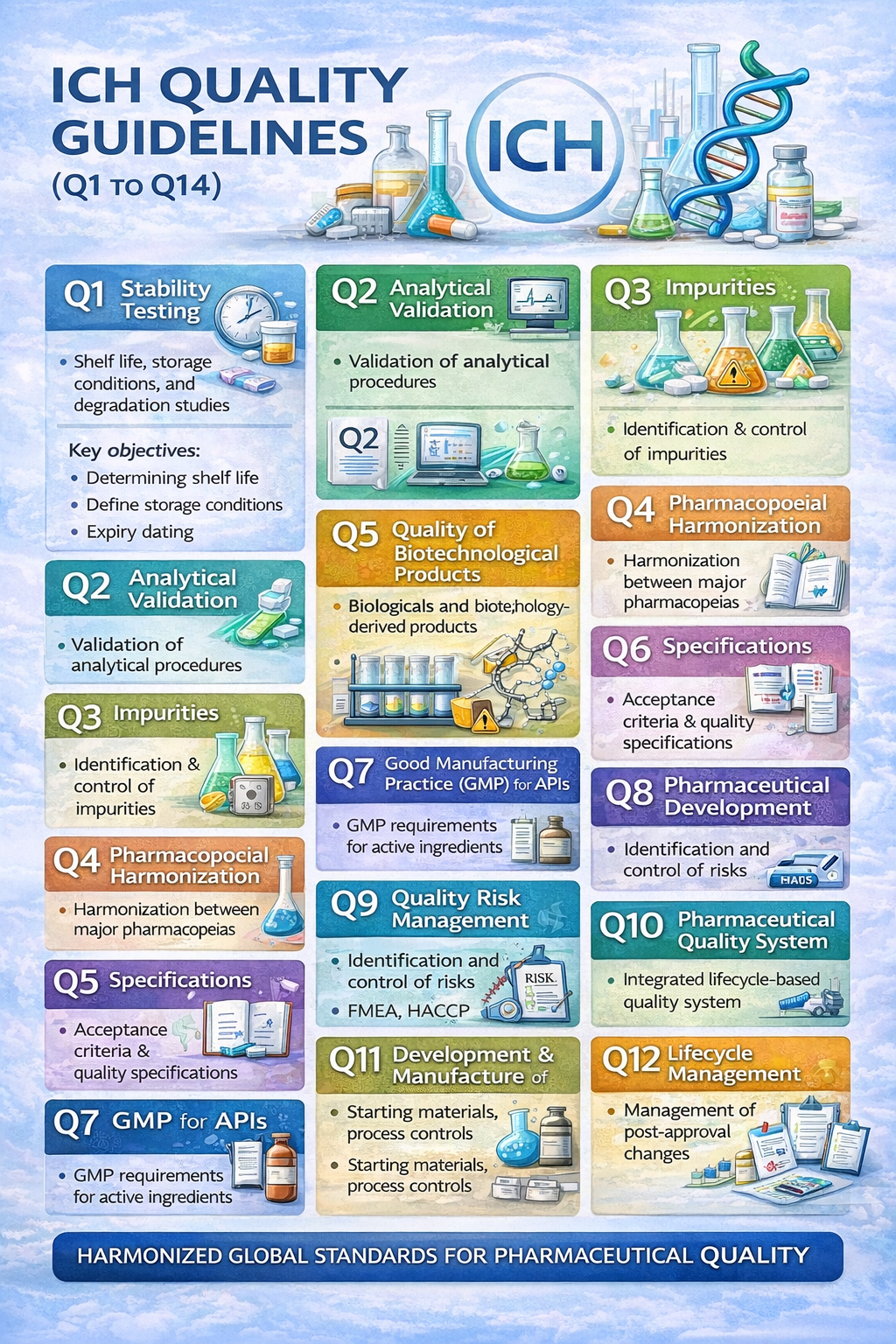
ICH Quality Guidelines (Q1 to Q14)
ICH Quality Guidelines (Q1 to Q14)
The ICH Quality (Q) guidelines are developed by the International Council for Harmonisation of Technical Requirements for Pharmaceuticals for Human Use to harmonize pharmaceutical quality standards across regions. They are implemented by major regulators including the U.S. Food and Drug Administration and the European Medicines Agency. The Q-series provides globally aligned expectations for Chemistry, Manufacturing, and Controls (CMC), covering development, stability, manufacturing, risk management, and lifecycle control.
 Q1 – Stability Testing
Purpose: Establish stability profile of drug substances and drug products.
| Sub-Guideline | Scope |
|---|---|
| Q1A | Stability testing of new drug substances and products; long-term, intermediate, and accelerated studies; expiry dating |
| Q1B | Photostability testing to evaluate light sensitivity |
| Q1C | Stability testing for new dosage forms |
| Q1D | Bracketing and matrixing designs to reduce sample numbers |
| Q1E | Statistical evaluation of stability data |
| Q1F (withdrawn) | Stability for climatic zones III and IV |
Objectives include determination of shelf life, storage conditions, and degradation pathways.
Q2 and Q14 – Analytical Procedures
| Guideline | Focus |
|---|---|
| Q2(R2) | Validation of analytical procedures |
| Q14 | Analytical procedure development and lifecycle management |
Validation characteristics include accuracy, precision, specificity, linearity, range, detection limit, quantitation limit, and robustness. These apply to assay methods and impurity testing.
Q3 – Impurities
| Sub-Guideline | Scope |
|---|---|
| Q3A | Impurities in new drug substances |
| Q3B | Impurities in new drug products |
| Q3C | Residual solvents classification (Class 1, 2, 3) |
| Q3D | Elemental impurities using risk-based approach |
Ensures identification, qualification, and control of impurities.
Q4 – Pharmacopoeial Harmonization
| Pharmacopeia | Region |
|---|---|
| United States Pharmacopeia | United States |
| European Pharmacopoeia | Europe |
| Japanese Pharmacopoeia | Japan |
Promotes harmonized pharmacopoeial requirements and reduces duplicate testing.
Q5 – Quality of Biotechnological Products
| Sub-Guideline | Focus |
|---|---|
| Q5A | Viral safety evaluation |
| Q5B | Expression construct analysis |
| Q5C | Stability of biotechnological products |
| Q5D | Cell substrates |
| Q5E | Comparability of biotechnological products |
Applies to biotechnology-derived and biological products.
Q6 – Specifications
| Sub-Guideline | Scope |
|---|---|
| Q6A | Specifications for chemical drug substances and products |
| Q6B | Specifications for biotechnological products |
Defines test procedures, acceptance criteria, and release specifications.
Q7 – GMP for Active Pharmaceutical Ingredients
Provides Good Manufacturing Practice requirements for APIs.
| Area | Coverage |
|---|---|
| Personnel | Qualification and training |
| Equipment | Design and maintenance |
| Documentation | Records and traceability |
| Production Controls | Process consistency |
| Quality Control | Testing and batch release |
Q8 – Pharmaceutical Development
Introduces Quality by Design (QbD).
| Concept | Description |
|---|---|
| Critical Quality Attributes (CQAs) | Characteristics affecting product performance |
| Critical Process Parameters (CPPs) | Variables impacting CQAs |
| Design Space | Multidimensional operational range |
| Risk-Based Development | Scientific and systematic approach |
Encourages enhanced product and process understanding.
Q9 – Quality Risk Management
Provides structured risk management tools.
| Tool | Purpose |
|---|---|
| Failure Mode and Effects Analysis (FMEA) | Identify potential failures |
| Hazard Analysis and Critical Control Points (HACCP) | Prevent process hazards |
| Risk Ranking | Prioritize risks |
Supports proactive risk control.
Q10 – Pharmaceutical Quality System
Describes an integrated lifecycle-based quality system.
| Element | Description |
|---|---|
| Management Responsibility | Oversight and accountability |
| CAPA | Corrective and preventive actions |
| Change Management | Controlled changes |
| Continuous Improvement | Ongoing quality enhancement |
Q11 – Development and Manufacture of Drug Substances
| Area | Scope |
|---|---|
| Starting Materials | Selection and justification |
| Process Development | Scientific understanding |
| Control Strategy | Defined quality controls |
Applies to both chemical and biotechnology-derived substances.
Q12 – Lifecycle Management
| Feature | Description |
|---|---|
| Established Conditions | Defined regulatory commitments |
| Post-Approval Change Management Protocol (PACMP) | Structured change implementation |
| Lifecycle Approach | Efficient management of post-approval changes |
Facilitates regulatory flexibility for low-risk updates.
Q13 – Continuous Manufacturing
| Focus Area | Description |
|---|---|
| Control Strategy | Integrated quality oversight |
| Real-Time Monitoring | Process analytical technologies |
| Continuous Validation | Ongoing process verification |
Supports advanced and modern manufacturing approaches.
The ICH Q1–Q14 guidelines collectively provide a harmonized, science-based, and risk-oriented framework ensuring consistent global standards for pharmaceutical quality throughout the product lifecycle.
