 Sign in with Google
Safety Changes
What Is Safety Changes?
Safety Changes refer to regulatory updates made to product labeling when new risk information emerges after a medicine is approved. These changes are critical because they directly affect patient safety and the overall benefit–risk balance of the product. Safety changes can impact professional labeling such as USPI and SmPC, as well as patient-facing documents like PIL and Medication Guides.
Regulatory Responsibility
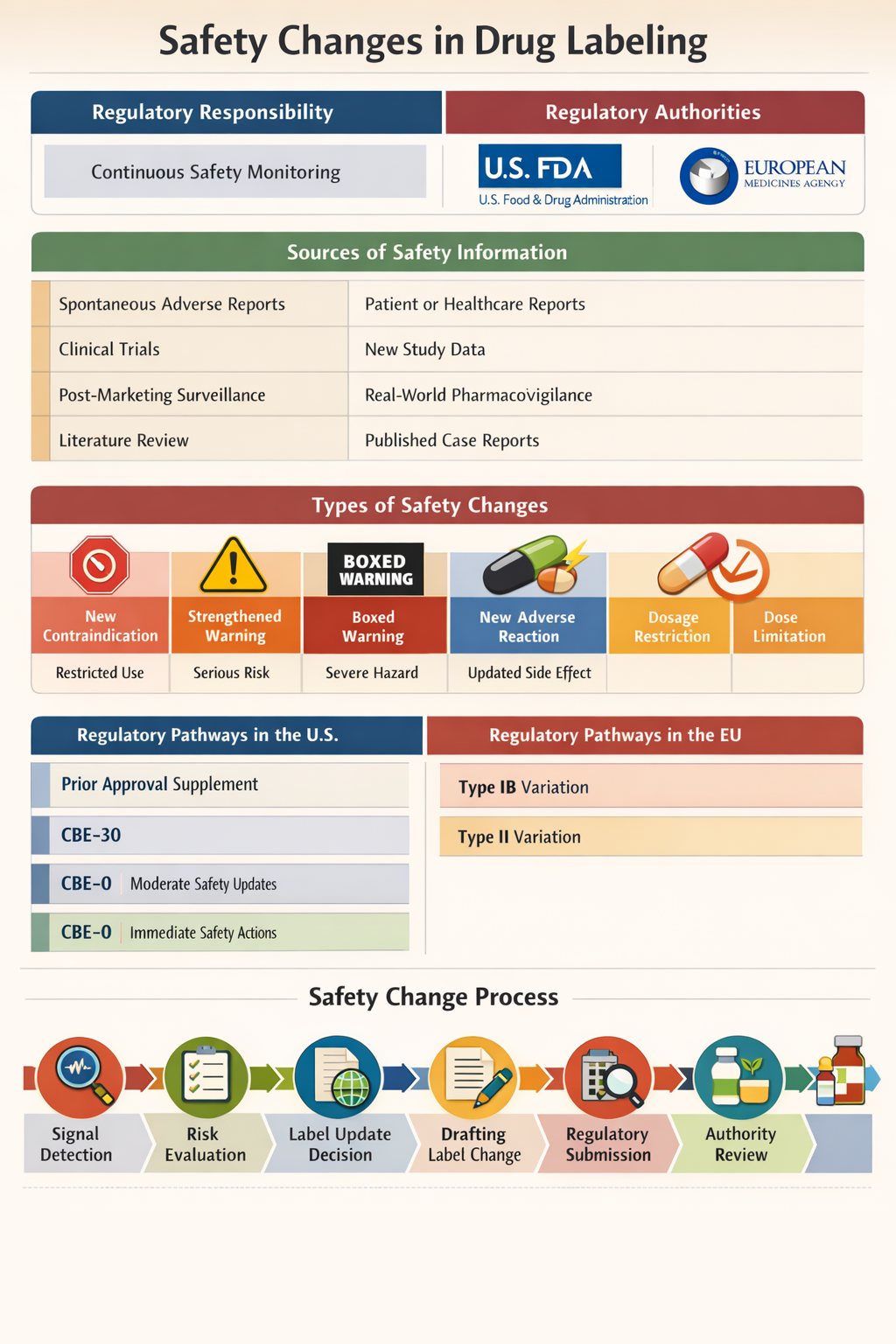
After approval, the Marketing Authorization Holder has a continuous obligation to monitor safety through pharmacovigilance systems. Regulatory authorities such as the U.S. Food and Drug Administration and the European Medicines Agency require companies to evaluate new safety information and update labeling without delay when necessary.
Sources of Safety Information
Safety changes are triggered by scientific evaluation of new data. The most common sources are summarized below.
| Source | Description |
|---|---|
| Spontaneous Adverse Event Reports | Individual case safety reports from healthcare professionals or patients |
| Post-Marketing Surveillance | Signal detection through pharmacovigilance databases |
| Clinical Trials | New adverse events identified in ongoing or completed studies |
| Literature Review | Published case reports or meta-analyses |
| Regulatory Authority Communication | Mandated safety updates |
| Risk Management Plan Review | Identification of emerging risks |
Types of Safety Changes
Safety updates may involve strengthening existing warnings or adding entirely new risk information.
| Type of Safety Change | Example |
|---|---|
| New Contraindication | Addition of a disease condition where drug must not be used |
| Strengthened Warning | Upgrading precaution to serious warning |
| Boxed Warning Addition | Highlighting life-threatening risk |
| New Adverse Reaction | Inclusion of newly identified side effect |
| Dosage Restriction | Limiting dose in certain populations |
| Monitoring Requirement | Mandatory laboratory monitoring |
Regulatory Pathways in the United States
In the US, safety-related labeling changes are submitted as supplements to the approved application.
| Submission Type | When Used |
|---|---|
| Prior Approval Supplement | Major safety changes such as boxed warning |
| CBE-30 | Moderate safety update requiring review period |
| CBE-0 | Immediate implementation to strengthen safety information |
For urgent safety issues, companies may implement a CBE-0 change immediately upon submission while awaiting review by the U.S. Food and Drug Administration.
Regulatory Pathways in the European Union
In the EU, safety changes are submitted as variations.
| Variation Category | Typical Use |
|---|---|
| Type IB | Minor safety clarification |
| Type II | Significant safety impact affecting benefit-risk |
For centrally authorized products, safety changes are assessed by the Pharmacovigilance Risk Assessment Committee under the European Medicines Agency framework.
Global Safety Change Process
In multinational companies, safety changes often begin with revision of the Company Core Safety Information within the CCDS. Once updated at global level, country affiliates align local labeling such as USPI, SmPC, and PIL through appropriate submissions.
Safety Change Workflow
| Step | Activity |
|---|---|
| Signal Detection | Identification of potential safety risk |
| Signal Validation | Medical assessment of causal association |
| Benefit-Risk Evaluation | Determination of clinical impact |
| Global Label Decision | Update to core safety information |
| Drafting of Revised Text | Preparation of updated labeling language |
| Regulatory Submission | Filing supplement or variation |
| Authority Review and Approval | Assessment by regulatory agency |
| Implementation | Update in packaging and electronic systems |
High-Impact Safety Changes
Certain safety changes significantly affect product use and may alter prescribing behavior. Examples include addition of serious hepatotoxicity warning, risk of fatal hypersensitivity reaction, teratogenic risk in pregnancy, or restriction of pediatric use. Such updates may also require Direct Healthcare Professional Communications or safety alerts.
Inspection and Compliance Perspective
Regulatory authorities review whether safety signals were evaluated promptly and whether labeling changes were implemented within required timelines. Delayed updates may lead to inspection findings, warning letters, or compliance actions.
Role in Regulatory Affairs and Pharmacovigilance
Safety changes require strong coordination between pharmacovigilance, medical writing, regulatory affairs, and clinical teams. Pharmacovigilance identifies and evaluates the risk. Medical writers draft scientifically accurate and regulatorily compliant language. Regulatory affairs determines the appropriate submission pathway and manages agency interactions.
Safety changes are therefore central to lifecycle management and are directly linked to patient protection, regulatory compliance, and company accountability.
