 Sign in with Google
Artwork Review
What Is Artwork Review?
Artwork Review in the pharmaceutical industry refers to the structured evaluation of printed packaging materials to ensure accuracy, regulatory compliance, and consistency with approved labeling. It is a critical quality control step before commercial distribution of a medicinal product.
Artwork includes all printed components associated with a product. This typically covers carton labels, container labels, blister foils, bottle labels, package inserts such as PIL, and any outer packaging text. The review ensures that all text, symbols, formatting, and regulatory statements match the latest approved labeling documents such as USPI, SmPC, or PIL.
Regulatory Framework
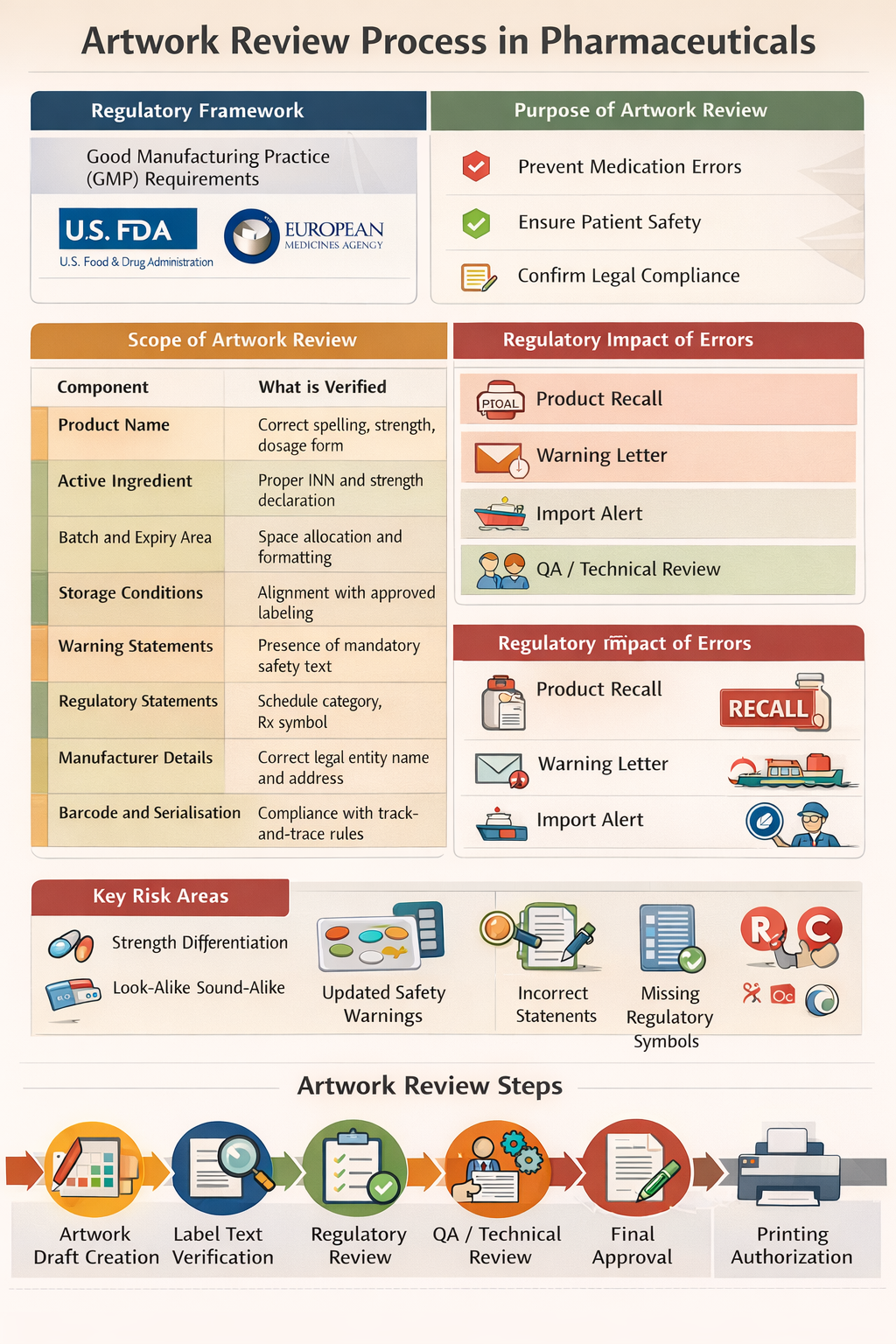
Artwork review is governed by Good Manufacturing Practice requirements enforced by authorities such as the U.S. Food and Drug Administration and the European Medicines Agency. In the EU, it must also comply with Directive 2001/83/EC labeling provisions. Any discrepancy between approved labeling and printed artwork can result in regulatory findings.
Purpose of Artwork Review
The primary purpose is to prevent medication errors, ensure patient safety, and confirm legal compliance. Packaging errors such as incorrect strength, wrong dosage instructions, missing warnings, or outdated revision dates can lead to product recalls and serious regulatory consequences.
Scope of Artwork Review
| Component | What is Verified |
|---|---|
| Product Name | Correct spelling, strength, dosage form |
| Active Ingredient | Proper INN and strength declaration |
| Batch and Expiry Area | Space allocation and formatting |
| Storage Conditions | Alignment with approved labeling |
| Warning Statements | Presence of mandatory safety text |
| Regulatory Statements | Schedule category, Rx symbol |
| Manufacturer Details | Correct legal entity name and address |
| Barcode and Serialisation | Compliance with track-and-trace rules |
Types of Artwork Review
Artwork review may be categorized based on stage and purpose.
| Type | Description |
|---|---|
| Initial Artwork Review | Review of newly created packaging |
| Revised Artwork Review | Review after label update or variation |
| Market-Specific Review | Country-specific compliance verification |
| Technical Review | Dimensional and printing specification check |
Artwork Review Workflow
| Step | Activity |
|---|---|
| Artwork Draft Creation | Design team prepares packaging layout |
| Label Text Verification | Comparison against approved labeling |
| Regulatory Review | Confirmation of compliance with authority requirements |
| Quality Assurance Review | GMP compliance check |
| Final Approval | Authorized sign-off |
| Printing Authorization | Release to printer |
Key Risk Areas
High-risk areas in artwork review include strength differentiation for multiple strengths, look-alike sound-alike product names, updated safety warnings not implemented, incorrect storage statements, and missing mandatory symbols such as “For prescription use only.”
Regulatory Impact of Errors
Artwork errors may lead to regulatory actions such as product recalls, warning letters, import alerts, or inspection observations. Authorities evaluate artwork control procedures during GMP inspections. Lack of version control or failure to implement approved safety updates is considered a compliance deficiency.
Role in Regulatory Affairs and Quality
Regulatory affairs ensures that artwork content aligns with approved USPI or SmPC. Quality assurance ensures change control documentation and version management. Pharmacovigilance ensures that new safety changes are reflected in packaging materials.
Lifecycle Management
Artwork must be updated whenever there is a labeling variation, safety update, manufacturing site change, or branding modification. Controlled document management systems are used to maintain version history and prevent distribution of obsolete artwork.
In pharmaceutical operations, artwork review is not a design activity but a regulated quality process directly linked to patient safety and legal compliance.
