
 Sign in with Google
Submission Compilation
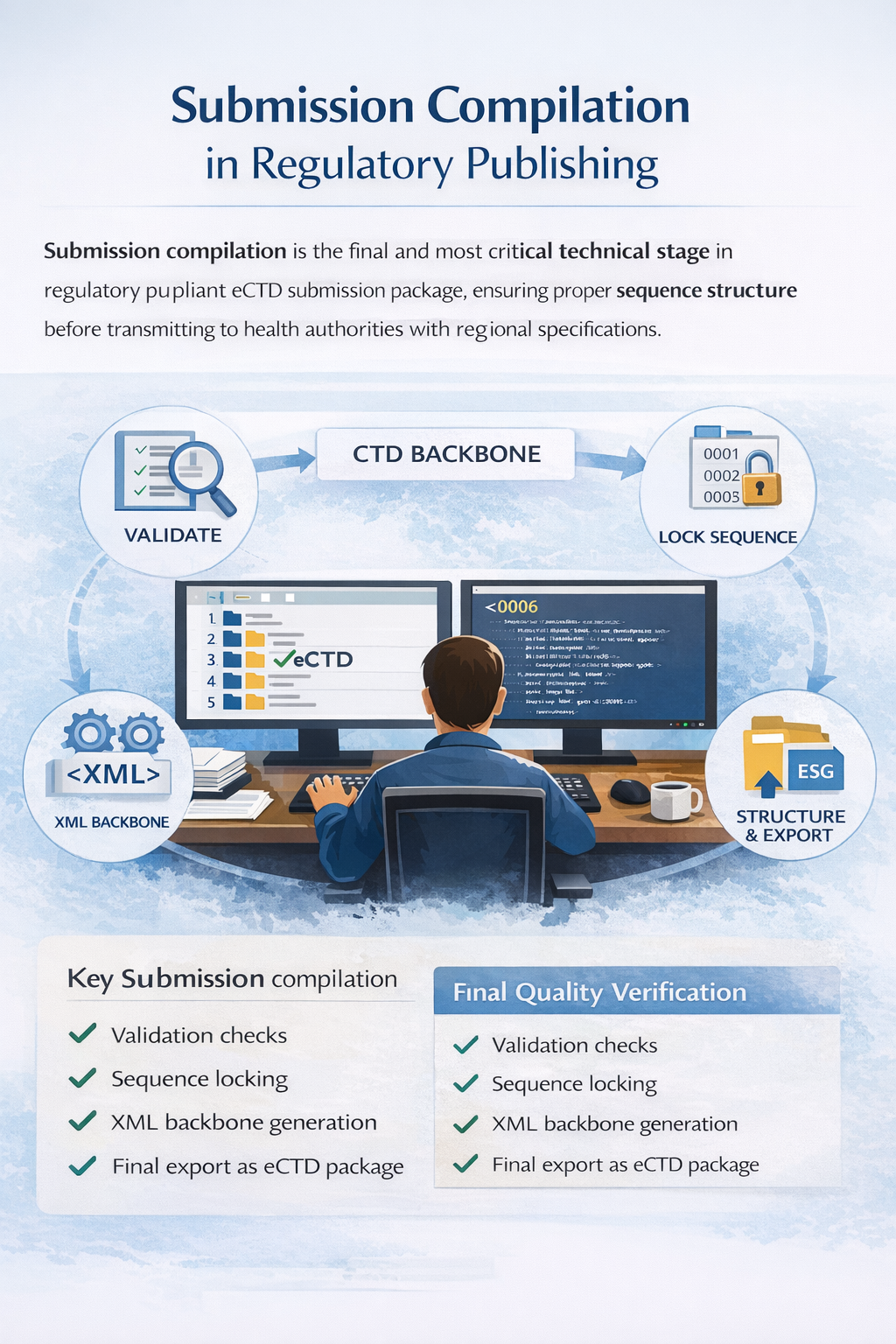
Submission compilation is the final and most critical technical stage in the regulatory publishing workflow. It is the process by which all validated, quality-checked, lifecycle-controlled documents are assembled into a finalized electronic sequence ready for transmission to regulatory authorities. This stage occurs after document preparation, bookmarking, hyperlinking, metadata entry, lifecycle assignment, XML backbone generation, and validation have been successfully completed.
In practical industry settings, submission compilation is performed within regulatory publishing software such as eCTD management tools used by global pharmaceutical companies. A publishing associate must understand that compilation is not merely “zipping files.” It is a controlled process that generates a structured, agency-ready submission package compliant with regional specifications.
Purpose of Submission Compilation
The objective of submission compilation is to generate a complete electronic submission sequence that includes the CTD folder hierarchy, XML backbone file, document leaf nodes, lifecycle references, and regional administrative structure. The compiled output must strictly match regulatory technical standards before transmission through authorized electronic gateways.
Key Objectives of Submission Compilation
| Objective | Practical Significance |
|---|---|
| Sequence Finalization | Locks submission structure |
| XML Confirmation | Ensures backbone integrity |
| Document Integrity | Confirms correct file mapping |
| Lifecycle Accuracy | Maintains proper regulatory history |
| Readiness for Transmission | Generates gateway-compatible output |
If compilation is incorrect, regulatory technical validation will fail even if all documents are scientifically sound.
Pre-Compilation Requirements
Before compilation is initiated, several checkpoints must be complete. These checkpoints ensure that no structural or technical inconsistencies remain.
Pre-Compilation Checklist
| Requirement | Description |
|---|---|
| Validation Status | All technical errors resolved |
| Metadata Verification | Application data confirmed |
| Lifecycle Review | Correct referencing of prior sequences |
| Document Placement Review | Correct CTD node mapping |
| QC Approval | Internal quality sign-off obtained |
Once compilation begins, changes are usually restricted. Therefore, verification before proceeding is essential.
Compilation Process in Publishing Software
During compilation, the publishing software performs multiple automated tasks. First, it locks the submission sequence. Locking prevents accidental modification of documents, metadata, or lifecycle operators. Second, the software regenerates and finalizes the XML backbone to ensure structural accuracy. Third, all linked documents are copied into a final output directory structured according to regional DTD requirements.
The output typically includes:
Final Submission Components
| Component | Function |
|---|---|
| CTD Folder Structure | Hierarchical module organization |
| XML Backbone File | Structural index of submission |
| PDF Documents | Leaf node content files |
| Regional Administrative Files | Application-specific forms |
All files are arranged in precise folder paths expected by regulatory agency validation systems.
Sequence Management During Compilation
Every submission is assigned a unique sequence number. Sequence numbers must be incremental and historically traceable. For example, initial marketing application may be sequence 0000, followed by amendments such as 0001, 0002, and so forth.
Improper sequence numbering disrupts lifecycle history and may result in technical rejection. Publishing professionals must confirm that the correct prior sequence is referenced when lifecycle operators such as replace or append are used.
Common Compilation Errors
Although compilation is largely automated, operational errors can occur due to incorrect preparatory steps.
| Error | Impact |
|---|---|
| Incorrect sequence number | Lifecycle conflict |
| Missing leaf document | Validation error |
| Corrupted XML backbone | Technical rejection |
| Incorrect regional structure | DTD validation failure |
| Unresolved validation warnings | Transmission delay |
Many technical agency rejections originate at the compilation stage due to overlooked structural issues.
Final Quality Verification
Even after successful compilation, a final quality review is recommended. Publishing teams often open the compiled folder independently to verify that:
The XML file opens correctly
All documents are accessible
Folder hierarchy matches expected CTD layout
File names follow naming conventions
This additional verification layer safeguards against last-minute submission failures.
Transmission Readiness
Once compilation is confirmed, the submission package is transferred to the designated electronic submission gateway. The file format and structure must be exactly as generated by the publishing software. Manual modification of compiled output is strictly prohibited, as it can corrupt the XML structure.
After transmission, acknowledgment receipts are monitored to confirm successful technical acceptance by the regulatory authority.
Professional and Career Importance
From an industry perspective, submission compilation represents high accountability. A publishing associate handling compilation is entrusted with ensuring that months or years of development work are transmitted accurately and without technical error. Precision, discipline, and structured thinking are required competencies.
During interviews for Regulatory Publishing or Regulatory Operations roles, candidates are often assessed on their understanding of compilation workflow, sequence management, XML regeneration, and validation checks. Demonstrating clarity in explaining compilation steps differentiates trained professionals from theoretical learners.
Submission compilation is the final technical gateway before regulatory review begins. Mastery of this stage ensures compliance, protects submission timelines, and strengthens professional credibility within global regulatory operations.
