
 Sign in with Google
ICH Safety Guidelines (S Series)
ICH Safety Guidelines (S Series)
The ICH Safety (S) guidelines define harmonized requirements for nonclinical safety evaluation of pharmaceuticals before human clinical trials and marketing approval. They are developed under the International Council for Harmonisation of Technical Requirements for Pharmaceuticals for Human Use framework and implemented by regulators including the U.S. Food and Drug Administration and the European Medicines Agency.
The S-series primarily applies to nonclinical animal and in vitro safety studies, ensuring protection of clinical trial participants and patients.
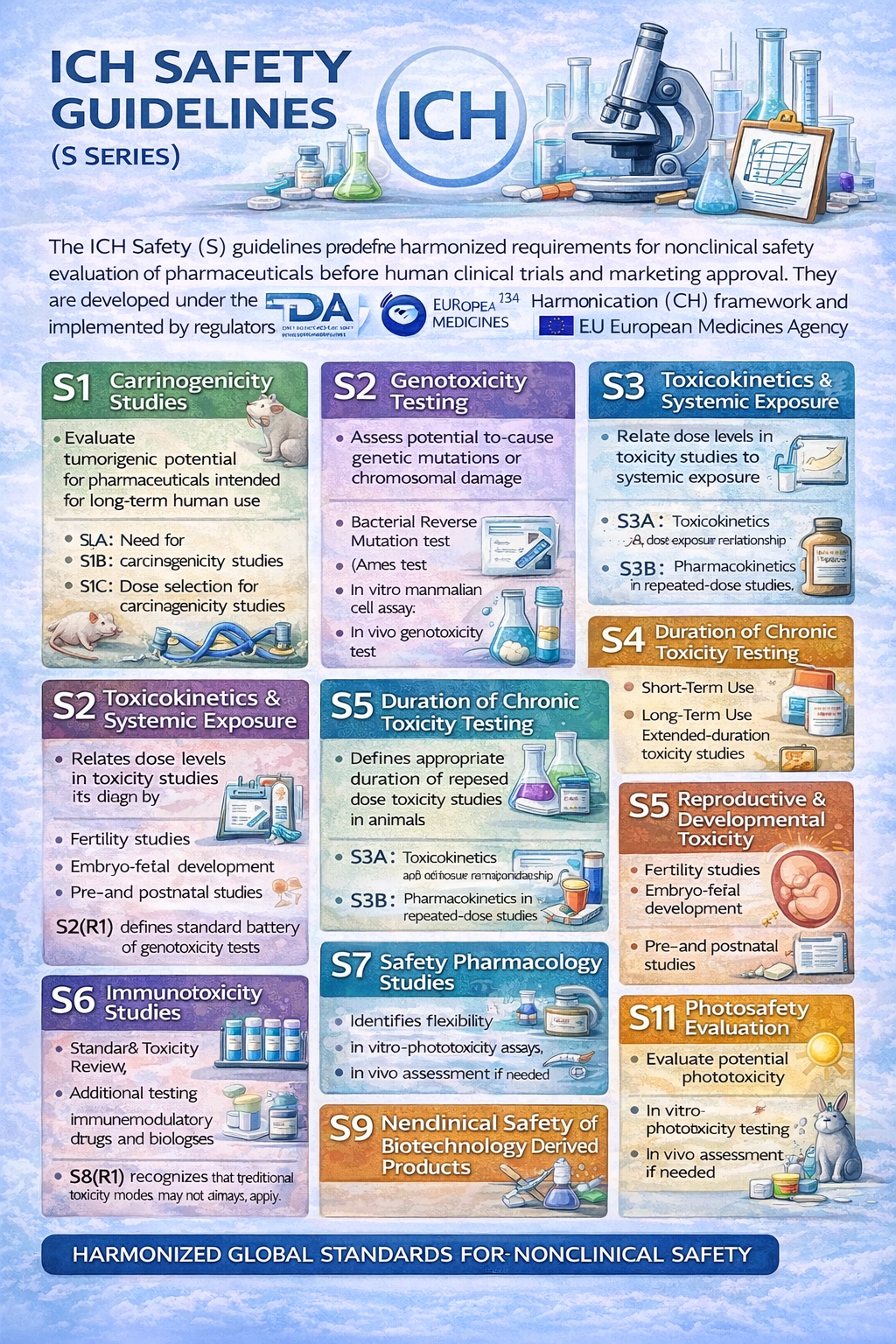 S1 – Carcinogenicity Studies
Purpose: Evaluate tumorigenic potential for pharmaceuticals intended for long-term use.
| Sub-Guideline | Scope |
|---|---|
| S1A | Need for carcinogenicity studies |
| S1B | Testing strategies for carcinogenicity |
| S1C | Dose selection for carcinogenicity studies |
Key elements include long-term rodent studies (typically 2 years), alternative transgenic models where appropriate, weight-of-evidence assessment, and relevance to clinical exposure duration.
S2 – Genotoxicity Testing
Purpose: Assess potential to cause genetic mutations or chromosomal damage.
| Component | Description |
|---|---|
| Bacterial Reverse Mutation Test | Ames test |
| In Vitro Mammalian Cell Assay | Chromosomal damage assessment |
| In Vivo Genotoxicity Test | Confirmation in animals |
S2(R1) defines the standard battery of genotoxicity tests. It supports identification of mutagenic compounds and impurity risk assessment.
S3 – Toxicokinetics and Systemic Exposure
Purpose: Relate dose levels in toxicity studies to systemic exposure.
| Sub-Guideline | Scope |
|---|---|
| S3A | Toxicokinetics and dose–exposure relationship |
| S3B | Pharmacokinetics in repeated-dose studies |
Establishes safety margins and supports translation of animal data to humans.
S4 – Duration of Chronic Toxicity Testing
Purpose: Define appropriate duration of repeated-dose toxicity studies.
| Treatment Category | Study Duration Alignment |
|---|---|
| Short-Term Use | Shorter animal study duration |
| Long-Term Use | Extended-duration toxicity studies |
Duration corresponds to intended clinical exposure period.
S5 – Reproductive and Developmental Toxicity
Purpose: Evaluate effects on fertility and development.
| Study Type | Focus |
|---|---|
| Fertility Studies | Male and female reproductive function |
| Embryo-Fetal Development | Teratogenicity and fetal development |
| Pre- and Postnatal Studies | Development after birth |
S5(R3) integrates these studies. Critical for products intended for women of childbearing potential.
S6 – Preclinical Safety of Biotechnology-Derived Products
Applies to monoclonal antibodies, recombinant proteins, and biologics.
| Focus Area | Consideration |
|---|---|
| Species Selection | Pharmacologically relevant species |
| Immunogenicity | Anti-drug antibody responses |
| Safety Pharmacology | Target-related risks |
| Reproductive Toxicity | Case-specific evaluation |
S6(R1) recognizes that traditional toxicity models may not always apply to biologics.
S7 – Safety Pharmacology Studies
Purpose: Identify undesirable pharmacodynamic effects on vital organ systems.
| Sub-Guideline | Focus |
|---|---|
| S7A | Core safety pharmacology battery |
| S7B | QT interval prolongation and proarrhythmic risk |
Core systems evaluated include cardiovascular, central nervous, and respiratory systems.
S8 – Immunotoxicity Studies
Purpose: Assess adverse effects on the immune system.
| Assessment Type | Scope |
|---|---|
| Standard Toxicity Review | Immune-related endpoints |
| Additional Testing | Triggered when immunotoxic risk is suspected |
Important for immunomodulatory drugs and biologics.
S9 – Nonclinical Evaluation for Anticancer Pharmaceuticals
Applies specifically to oncology products.
| Principle | Regulatory Flexibility |
|---|---|
| Risk–Benefit Balance | Greater flexibility due to life-threatening indication |
| Reduced Testing | Certain studies may be abbreviated |
| Earlier Clinical Entry | Supported for oncology drugs |
Allows modified nonclinical requirements compared to non-oncology products.
S10 – Photosafety Evaluation
Purpose: Evaluate potential phototoxicity.
| Trigger | Evaluation |
|---|---|
| UV-Visible Light Absorption | In vitro phototoxicity testing |
| Significant Skin/Eye Exposure | In vivo assessment if needed |
Ensures safety for drugs with light absorption properties.
S11 – Nonclinical Safety Testing for Pediatric Medicines
Purpose: Provide guidance for juvenile animal studies when pediatric development is planned.
| Focus Area | Consideration |
|---|---|
| Developmental Stage | Age-appropriate toxicity assessment |
| Scientific Justification | Not automatically required |
S11 ensures appropriate safety evaluation when pediatric use is anticipated.
The ICH S-series guidelines provide a comprehensive, harmonized framework for nonclinical safety evaluation, supporting global consistency and protection of human subjects before clinical and marketing authorization stages.
