
 Sign in with Google
Module 3 Quality Documentation
Introduction
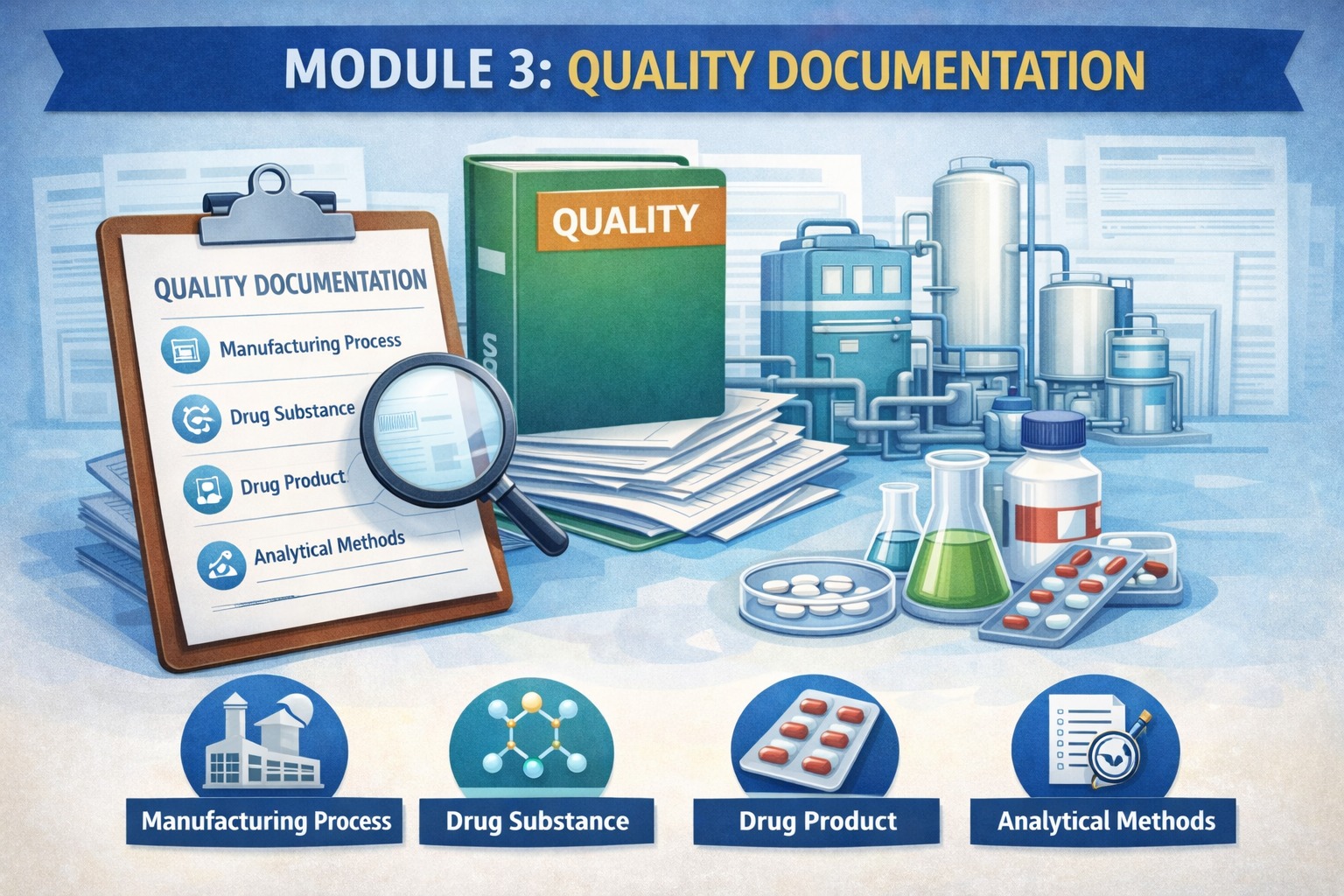
Module 3 of the Common Technical Document (CTD) focuses on quality documentation, also referred to as Chemistry, Manufacturing, and Controls (CMC). It is a harmonized module under ICH guidelines and provides detailed information about the drug substance, drug product, and manufacturing processes. Module 3 is critical because it demonstrates that the pharmaceutical product is consistently manufactured to meet predefined quality standards and specifications. Regulatory authorities rely heavily on Module 3 to assess product quality, safety, stability, and compliance with Good Manufacturing Practices (GMP). For Regulatory Affairs professionals, preparing Module 3 requires a deep understanding of pharmaceutical development, analytical methods, regulatory requirements, and cross-functional coordination with quality, manufacturing, and analytical teams.
Purpose of Module 3
The main purpose of Module 3 is to provide regulators with comprehensive documentation of the product’s quality to ensure its safety, efficacy, and consistency. This module demonstrates that the product can be manufactured reproducibly and meets all specifications for identity, purity, potency, and stability. Module 3 also provides supporting data for post-approval changes, variations, and lifecycle management. Proper preparation of Module 3 is essential to avoid regulatory delays, ensure compliance with international standards, and build confidence in the product’s quality. For professionals, Module 3 is the most technical section of the CTD and requires careful organization and attention to detail.
Content of Module 3
| Section | Description |
|---|---|
| Drug Substance | Provides detailed information on the active pharmaceutical ingredient (API), including nomenclature, structure, properties, and manufacturing process. Includes description of raw materials, starting materials, reagents, solvents, and critical process steps. |
| Drug Substance Specifications | Defines tests, analytical methods, acceptance criteria, and stability data for the drug substance to ensure identity, purity, and potency. Includes control strategies and justifications for each test. |
| Drug Substance Manufacturing Process | Describes the complete manufacturing process of the API, including flow diagrams, batch formula, in-process controls, and critical process parameters. Provides information on scale-up, process validation, and consistency. |
| Drug Product | Provides details about the final dosage form, including composition, formulation development, excipients, packaging materials, and manufacturing process. Includes methods for blending, granulation, compression, coating, or filling as applicable. |
| Drug Product Specifications | Outlines tests and analytical methods for the drug product, including physical, chemical, and microbiological tests. Includes acceptance criteria, validation of analytical methods, and reference standards. |
| Control of Critical Steps and Intermediates | Describes in-process controls, critical quality attributes, and monitoring of intermediate products to ensure quality throughout manufacturing. |
| Stability Data | Presents stability studies under ICH-recommended conditions, demonstrating shelf life, storage requirements, and degradation profiles. Includes real-time, accelerated, and stress testing data. |
| Packaging and Labeling | Provides information about primary and secondary packaging, container closure systems, and labeling specifications. Ensures that the product remains stable, safe, and properly identified. |
| Comparability and Bridging Studies | For post-approval changes, provides data demonstrating that manufacturing changes do not impact product quality or performance. |
Practical Application in Regulatory Submissions
Module 3 is central to regulatory assessment because quality is a critical determinant of product approval. Regulatory Affairs professionals must coordinate closely with manufacturing, quality control, analytical development, and formulation teams to compile Module 3. Key responsibilities include ensuring that data are accurate, complete, and aligned with regional guidelines, integrating cross-functional inputs, and presenting information logically. Proper documentation allows regulatory authorities to verify that the manufacturing process is robust, reproducible, and compliant with GMP. Module 3 also serves as the reference for post-marketing changes, process improvements, or scale-up activities, making it an essential component for lifecycle management.
Common Challenges and Best Practices
One major challenge in Module 3 is managing the volume and complexity of technical data. Ensuring consistency between drug substance and drug product information, validating analytical methods, and presenting stability data clearly are critical for successful submission. Best practices include using standardized templates for each section, performing thorough cross-functional reviews, applying proper version control for technical documents, and maintaining robust references to supporting data. Tables, flow diagrams, and figures are recommended to enhance clarity and facilitate regulatory review. Staying updated on ICH guidelines, regional requirements, and GMP expectations ensures compliance and reduces the risk of regulatory queries.
Conclusion
Module 3 is a cornerstone of the CTD that provides comprehensive quality documentation for the drug substance, drug product, and manufacturing processes. Mastery of Module 3 preparation demonstrates the ability to ensure product quality, compliance with international standards, and readiness for regulatory review. For Regulatory Affairs professionals, Module 3 requires technical knowledge, meticulous organization, and cross-functional coordination. Proper preparation reduces approval delays, supports post-marketing changes, and ensures that pharmaceutical products are consistently safe, effective, and high-quality. Understanding Module 3 equips job-ready candidates with the skills necessary to contribute to successful global submissions and regulatory compliance.
