
 Sign in with Google
Module 2 Summaries
Introduction
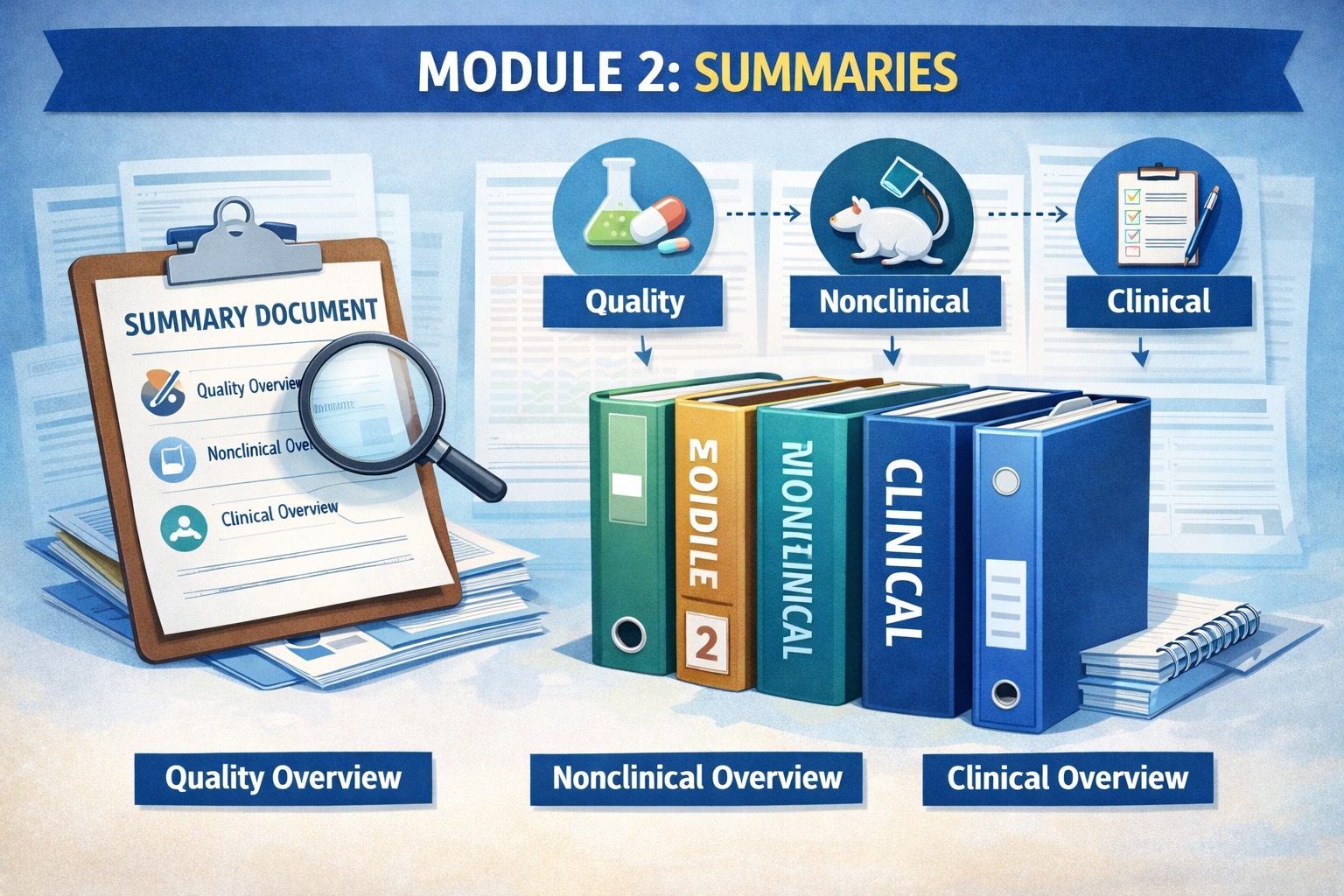
Module 2 of the Common Technical Document (CTD) serves as the summary and overview section of the submission. Unlike Module 1, which is administrative and region-specific, Module 2 is fully harmonized under ICH guidelines. Its primary function is to provide regulatory authorities with a high-level overview of the quality, nonclinical, and clinical data contained in Modules 3, 4, and 5. Module 2 acts as a bridge between the administrative Module 1 and the detailed scientific data, allowing reviewers to understand the overall rationale, organization, and conclusions of the dossier before delving into the technical sections. For Regulatory Affairs professionals, accurate preparation of Module 2 is essential because it highlights the key information, integrates data across functions, and facilitates efficient review by authorities.
Purpose of Module 2
The main purpose of Module 2 is to present a concise, integrated, and easily interpretable summary of all critical scientific data. It allows regulatory reviewers to quickly assess the strength of the evidence for a product’s quality, safety, and efficacy. Module 2 reduces the need for regulators to search through extensive datasets and complex reports in Modules 3, 4, and 5, thereby accelerating the review process. It also provides a platform for applicants to present integrated analyses, cross-references, and rationale for the product, supporting the scientific and regulatory arguments for approval. Proper preparation of Module 2 demonstrates the applicant’s ability to organize data clearly, highlight critical findings, and communicate effectively with regulators.
Content of Module 2
| Section | Description |
|---|---|
| Quality Overall Summary (QOS) | Provides a high-level summary of the Chemistry, Manufacturing, and Controls (CMC) information. Summarizes the drug substance and drug product, manufacturing process, specifications, analytical methods, stability data, and key quality aspects. |
| Nonclinical Overview | Summarizes nonclinical study results from Module 4. Includes pharmacology, pharmacokinetics, and toxicology studies, integrating findings to support the safety profile of the product. Highlights major conclusions, study design, and rationale for dose selection in clinical trials. |
| Clinical Overview | Summarizes clinical study results from Module 5. Includes Phase I-IV clinical trial data, efficacy and safety outcomes, statistical analyses, and integrated risk-benefit assessment. Provides context and justification for the clinical development program. |
| Nonclinical Written and Tabular Summaries | Presents tabular and narrative summaries of nonclinical studies, allowing regulators to quickly assess study design, key findings, and overall safety conclusions. |
| Clinical Summaries | Presents concise summaries of clinical trials, including study objectives, design, population, results, and interpretation. May include integrated efficacy and safety summaries for regulatory assessment. |
Practical Application in Regulatory Submissions
Module 2 is central to regulatory review because it synthesizes the evidence presented in the detailed Modules 3, 4, and 5. Regulatory Affairs professionals must ensure that the summaries are accurate, consistent with the supporting data, and well-organized. Preparing Module 2 requires cross-functional collaboration between quality, nonclinical, and clinical teams to extract key information and present it in a clear, logical manner. In practice, Module 2 reduces the risk of misinterpretation by regulators, facilitates scientific discussions during review meetings, and provides a foundation for addressing regulatory queries. Professionals also use Module 2 to identify critical gaps, trends, or inconsistencies across modules before submission, improving overall dossier quality.
Common Challenges and Best Practices
One common challenge in preparing Module 2 is ensuring consistency with the detailed data in Modules 3, 4, and 5. Any discrepancy can raise queries and delay approval. Another challenge is presenting complex data concisely without losing critical information. Best practices include maintaining standardized templates for QOS, clinical, and nonclinical summaries, performing cross-functional review for accuracy, using tables and figures to enhance clarity, and highlighting critical findings that support the product’s safety and efficacy. Integration of narratives with tabular summaries is recommended to improve readability for regulatory reviewers. Using clear headings, consistent terminology, and cross-references to detailed reports ensures that Module 2 meets ICH requirements and facilitates a smooth review process.
Conclusion
Module 2 is a crucial component of the CTD that integrates and summarizes all critical data from quality, nonclinical, and clinical modules. It serves as a roadmap for regulators to understand the overall dossier, supporting efficient review and informed decision-making. For Regulatory Affairs professionals, mastery of Module 2 preparation is essential to ensure accuracy, consistency, and clarity. Properly structured summaries and overviews reduce review time, minimize queries, and enhance communication with authorities. Understanding Module 2 enables job-ready professionals to prepare high-quality dossiers, support regulatory strategy, and contribute effectively to global product approvals.
