
 Sign in with Google
Publishing Workflow
What Is Publishing Workflow?
Regulatory publishing is a structured regulatory operations process in which approved source documents are transformed into technically compliant electronic submissions in eCTD format. Pharmaceutical companies submitting to major health authorities such as the US Food and Drug Administration, the European Medicines Agency, and the Central Drugs Standard Control Organization must comply with strict electronic submission standards. Regulatory publishing software functions as the operational platform where document assembly, lifecycle management, XML backbone generation, validation, and final submission occur. For a candidate to become industry-ready, understanding this workflow in a systematic and practical manner is essential.
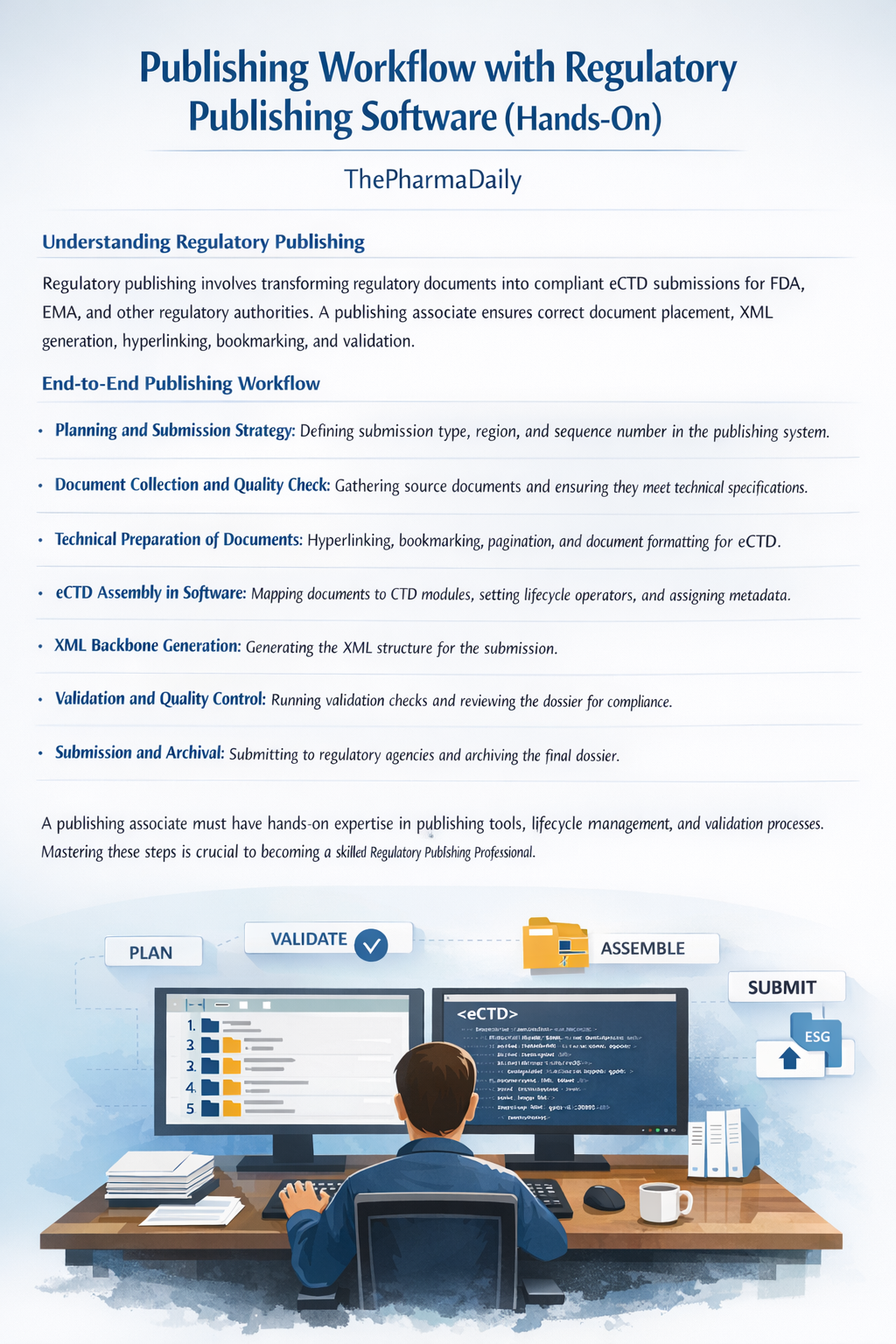
Overview of the End-to-End Publishing Workflow
| Phase | Stage Name | Core Objective | Primary Output |
|---|---|---|---|
| 1 | Submission Planning | Define regulatory strategy and sequence configuration | Configured application record |
| 2 | Document Collection & QC | Ensure technical compliance of source files | Submission-ready PDFs |
| 3 | Technical Preparation | Bookmarking, hyperlinking, granularity control | Optimized eCTD documents |
| 4 | eCTD Assembly | Map documents to CTD modules and assign lifecycle | Structured submission dossier |
| 5 | XML Backbone Generation | Generate structured XML index | Valid XML backbone |
| 6 | Validation & QC | Run system and regulatory checks | Validation-compliant package |
| 7 | Submission & Archival | Transmit to authority and archive records | Official submission sequence |
Phase 1: Submission Planning
Publishing begins after the Regulatory Affairs team finalizes submission type and strategy. The publishing associate creates a new application within the software and configures region, application number, and sequence number.
Key configuration parameters include:
| Parameter | Description | Importance |
|---|---|---|
| Region | US, EU, India, etc. | Determines regional DTD rules |
| Submission Type | Original, Amendment, Variation | Controls structure requirements |
| Sequence Number | Numeric tracking of submission lifecycle | Ensures chronological integrity |
| Application Type | NDA, ANDA, MAA, IND | Defines dossier pathway |
Accurate configuration prevents downstream XML validation failures.
Phase 2: Document Collection and Technical Quality Check
Source documents are received from cross-functional teams. Before importing them into publishing software, each file must pass technical quality standards.
Technical Compliance Checklist
| Checkpoint | Requirement | Risk if Non-Compliant |
|---|---|---|
| PDF Version | Acceptable regulatory version | Validation error |
| OCR | Text searchable | Agency technical rejection |
| Security | No password protection | Gateway failure |
| Orientation | Proper page view | Review difficulty |
| File Size | Within limit | Transmission rejection |
Failure at this stage increases rework and delays submission timelines.
Phase 3: Technical Preparation of Documents
Prepared documents must meet eCTD structural standards before assembly.
Document Optimization Requirements
| Task | Purpose | Professional Note |
|---|---|---|
| Bookmarking | Create hierarchical navigation | Must mirror document headings |
| Hyperlinking | Ensure cross-references work | Internal links only |
| Pagination | Continuous numbering | Required in clinical reports |
| Granularity | Split files per guidance | Avoid merging unrelated studies |
Granularity errors are one of the most common technical deficiencies observed during audits.
Phase 4: eCTD Assembly in Publishing Software
This is the core operational stage. Documents are imported and mapped into correct CTD modules.
Example CTD Placement Mapping
| CTD Module | Content Type | Example |
|---|---|---|
| Module 1 | Regional administrative | Application forms |
| Module 2 | Overviews and summaries | Quality Overall Summary |
| Module 3 | Quality CMC data | Stability Reports |
| Module 4 | Nonclinical reports | Toxicology studies |
| Module 5 | Clinical reports | Clinical Study Reports |
Lifecycle management is applied during this stage.
Lifecycle Operator Table
| Operator | Purpose | When Used |
|---|---|---|
| New | First-time submission | Initial placement |
| Replace | Substitute prior document | Updated report |
| Append | Add supplemental info | Additional data |
| Delete | Remove obsolete document | Withdrawal scenario |
Incorrect lifecycle linking directly results in XML validation failures.
Phase 5: XML Backbone Generation
Publishing software automatically generates the XML backbone after all documents are mapped and lifecycle operators assigned. The XML structure contains metadata, document hierarchy, and lifecycle references.
XML Structural Elements
| Element | Function |
|---|---|
| Application Information | Identifies product |
| Sequence Number | Identifies submission cycle |
| Leaf Elements | Represents individual documents |
| Metadata Attributes | Defines document properties |
Although auto-generated, publishing accuracy determines XML correctness.
Phase 6: Validation and Quality Control
Validation occurs at two levels, technical and regulatory.
Validation Categories
| Validation Type | Scope | Performed By |
|---|---|---|
| System Validation | Structural and XML checks | Publishing Software |
| Regulatory QC | Module alignment and completeness | Regulatory Team |
Common validation failures include broken hyperlinks, incorrect sequence referencing, metadata errors, invalid PDF properties, and incorrect document placement.
Multiple correction cycles are standard in real-world submissions.
Phase 7: Submission and Archival
After successful validation, the software compiles the submission for transmission. Depending on region, transmission occurs through electronic gateways.
Post-Submission Monitoring
| Stage | Description |
|---|---|
| Transmission | Upload to regulatory gateway |
| Acknowledgment | Receipt confirmation |
| Technical Acceptance | Agency-level validation outcome |
| Archival | Storage in document management system |
Publishing teams must track acknowledgment messages carefully to confirm technical acceptance.
Core Skills Required for Job Readiness
| Competency | Industry Expectation |
|---|---|
| CTD Structure Knowledge | Correct document mapping |
| Lifecycle Management | Accurate sequence maintenance |
| PDF Technical Skills | File optimization expertise |
| Validation Troubleshooting | Rapid error resolution |
| Attention to Detail | Zero structural error tolerance |
Regulatory publishing is precision-driven and compliance-intensive. Even minor metadata or lifecycle errors can delay high-value product approvals. A structured understanding of publishing workflow ensures readiness for roles such as Regulatory Publishing Associate, eCTD Specialist, and Regulatory Operations Executive. Mastery of this workflow elevates a beginner into a professionally competent regulatory publishing resource aligned with global pharmaceutical industry expectations.
