
 Sign in with Google
Submission Gateway
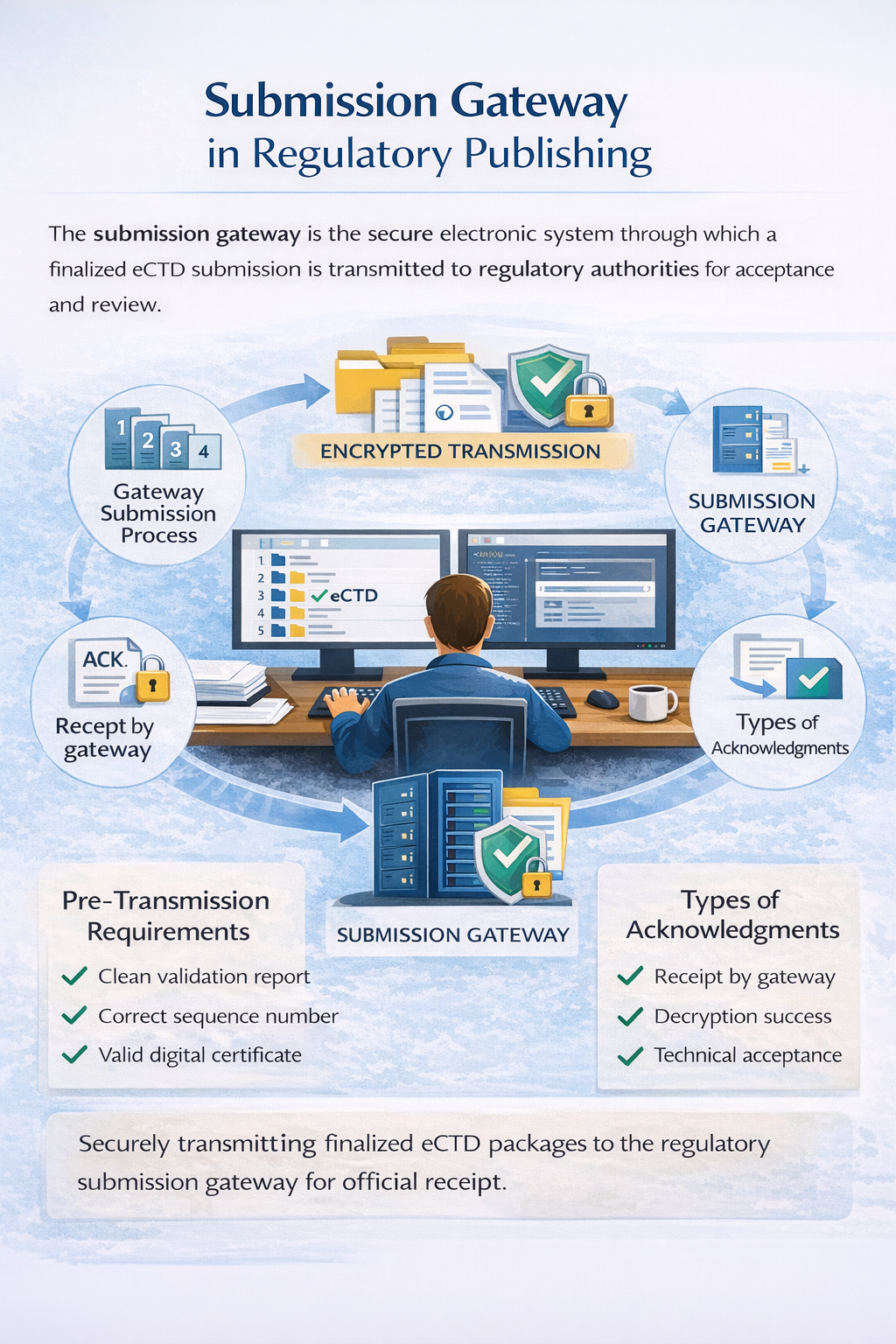
A Submission Gateway is a secure electronic platform used by regulatory authorities to receive eCTD and other electronic submissions from pharmaceutical companies. After successful validation and compilation, the finalized sequence is transmitted through the respective gateway where it undergoes encryption verification, authentication, and technical screening before entering the regulatory review process. The gateway acts as the official electronic entry point and confirms submission receipt through structured acknowledgment messages.
Major Regulatory Submission Gateways
| Region | Authority | Gateway System | Protocol |
|---|---|---|---|
| United States | US Food and Drug Administration | Electronic Submissions Gateway ESG | AS2 or WebTrader |
| European Union | European Medicines Agency | eSubmission Gateway | AS2 |
| United Kingdom | MHRA | MHRA Submissions Portal | Secure Web |
| Canada | Health Canada | Canadian Electronic Submission Gateway CESG | Web Upload |
| India | CDSCO | SUGAM Portal | Online Portal |
| Japan | PMDA | Electronic Gateway System | Dedicated Network |
Each gateway has authority specific configuration requirements such as submission type classification, application number formatting, sequence referencing, and envelope metadata structure.
Pre-Gateway Verification Requirements
| Requirement | Practical Check | Importance |
|---|---|---|
| Clean Validation Report | No critical errors in final validation log | Prevents technical rejection |
| Correct Sequence Number | Sequential progression confirmed | Maintains lifecycle integrity |
| Envelope Metadata Accuracy | Application and submission details verified | Ensures correct routing |
| Active Digital Certificate | Certificate validity confirmed | Enables authentication |
| Size Compliance | Package within authority limits | Avoids transmission failure |
All these parameters must be verified before initiating transmission because gateway systems reject submissions that do not meet security or metadata standards even if structurally valid.
Practical Gateway Workflow
In hands-on publishing practice, the publisher selects the locked and validated sequence, applies gateway configuration settings, attaches the digital certificate, and initiates transmission from within the publishing software or authority web client. The system encrypts the submission package using secure protocols such as AS2, generates a checksum for integrity validation, and transfers the data to the authority gateway server. After receipt, automated systems scan the package for viruses, authenticate sender credentials, and evaluate metadata consistency.
Acknowledgment Structure
| Acknowledgment | Generated By | Meaning | Action Required |
|---|---|---|---|
| ACK 1 | Gateway Server | Submission successfully received | Confirm receipt |
| ACK 2 | Decryption System | File decrypted and integrity verified | Ensure no corruption |
| ACK 3 | Authority Validation Engine | Technical acceptance into review system | Archive confirmation |
| Rejection Notice | Authority System | Technical or metadata issue identified | Correct and resubmit |
Receipt of the final acknowledgment confirms that the submission has officially entered the regulatory workflow and establishes the official filing date.
Envelope Metadata Components
| Metadata Field | Description |
|---|---|
| Application Number | Unique regulatory application identifier |
| Submission Type | Initial, Supplement, Variation, Amendment |
| Sequence Number | Incremental lifecycle sequence |
| Regulatory Activity | Description of submission purpose |
| Contact Information | Sponsor communication details |
Incorrect metadata entries are common causes of gateway level rejection and must be carefully reviewed prior to submission.
Security and Technical Framework
Gateway systems rely on digital certificates for authentication, encryption protocols for confidentiality, checksum algorithms for integrity, and firewall protections to safeguard regulatory infrastructure. Certificates must be periodically renewed and properly configured within the publishing software environment. Network configuration and endpoint accuracy are critical for uninterrupted transmission.
Common Gateway Errors and Resolution
| Error Type | Cause | Resolution |
|---|---|---|
| Certificate Expired | Invalid authentication credential | Renew and reinstall certificate |
| Metadata Rejection | Incorrect application or sequence data | Correct envelope and retransmit |
| Duplicate Sequence | Previously submitted sequence number | Assign next valid sequence |
| Connection Failure | Incorrect endpoint or firewall block | Verify configuration |
| File Size Limitation | Package exceeds threshold | Divide into permitted sequences |
Distinction Between Publishing Validation and Gateway Validation
| Publishing Validation | Gateway Validation |
|---|---|
| Ensures CTD structural compliance | Ensures secure transmission integrity |
| Checks XML, lifecycle operators, PDFs | Checks authentication and metadata envelope |
| Performed within publishing tool | Performed by authority server |
Understanding this distinction is essential for regulatory publishing professionals because a technically valid submission may still fail at transmission level if gateway configuration is incorrect.
Submission gateway expertise is a critical competency in regulatory publishing. It ensures secure filing, accurate timestamping, compliance with authority standards, and uninterrupted regulatory communication across global health authorities.
