 Sign in with Google
Module 1 Administrative Information
Introduction
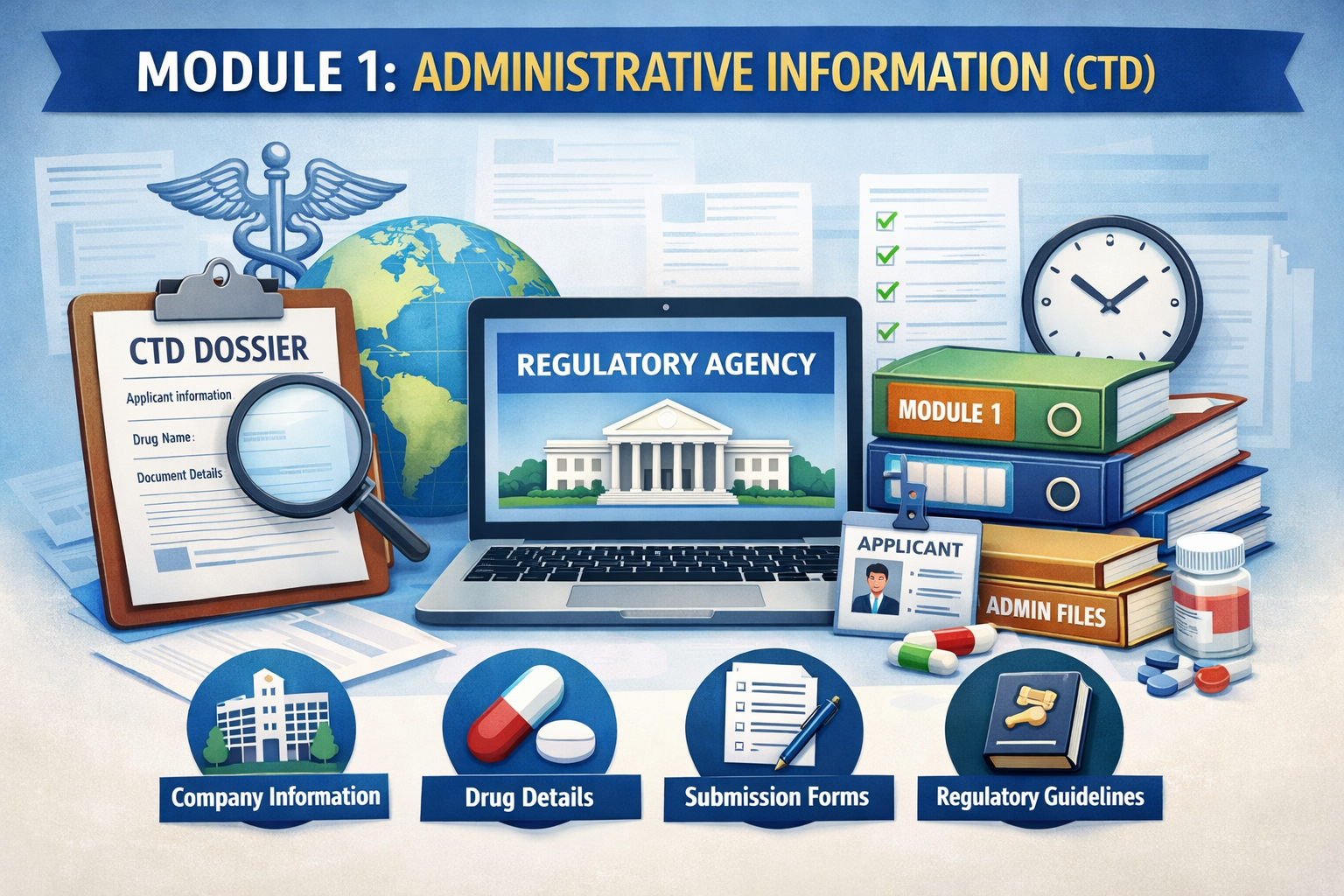
Module 1 of the Common Technical Document (CTD) serves as the administrative and regional section of the regulatory submission. Unlike Modules 2 through 5, which are harmonized globally under ICH guidelines, Module 1 is region-specific. Its purpose is to provide regulatory authorities with all administrative, procedural, and legal information required to accept, register, or review a product application. Module 1 forms the first impression of a submission, enabling reviewers to quickly identify the applicant, the product, the type of application, and compliance with regional regulations. Proper organization of Module 1 is crucial because any omission or error can delay the submission process, trigger additional queries, or even result in a rejection.
Module 1 is particularly important for multinational submissions because its content varies from region to region. For instance, the US FDA requires Form 356h for new drug applications, whereas the EMA follows the centralized application form format. India’s CDSCO requires region-specific regulatory forms, including product licenses and local GMP certifications. This regional specificity makes Module 1 a critical responsibility for Regulatory Affairs professionals, ensuring that all procedural requirements are accurately fulfilled for each jurisdiction.
Purpose of Module 1
The primary purpose of Module 1 is to ensure that the submission is administratively complete, legally compliant, and regionally acceptable. This module allows regulatory authorities to verify the following: the applicant is authorized, the product meets local legal and regulatory standards, submission fees have been paid, and all necessary supporting documents are attached. Module 1 also acts as a reference point for regulatory inspections, ensuring that proper documentation, certifications, and declarations have been submitted in accordance with regional guidelines. For Regulatory Affairs teams, mastery of Module 1 supports efficient dossier preparation, avoids unnecessary delays, and establishes credibility with authorities. Proper management of Module 1 is therefore essential for job-ready professionals handling global submissions.
Detailed Content of Module 1
| Section | Description and Key Components |
|---|---|
| Application Forms | Forms required by the regulatory authority, such as marketing authorization application forms, administrative checklists, and legal declarations. Each region has its own standardized forms, for example, the US FDA Form 356h and EMA’s eCTD application form. |
| Cover Letter | A formal introduction to the submission that identifies the applicant, product, and purpose of the submission. It often references prior communications, regulatory meetings, or existing approvals. The cover letter sets the context for the reviewers. |
| Labeling and Package Inserts | Drafts of product labels, cartons, and package inserts according to regional requirements. This includes prescribing information, dosage instructions, safety warnings, contraindications, and storage conditions. Proper labeling ensures regulatory compliance and patient safety. |
| Certificates and Authorizations | Region-specific certificates, including GMP compliance, product registration certificates, patents, and marketing authorizations. These documents demonstrate the applicant’s legal and regulatory compliance. |
| Regulatory Correspondence | Copies of previous approvals, communications, or official agency correspondence relevant to the submission. This ensures continuity of information and helps reviewers understand the product’s regulatory history. |
| Environmental and Safety Documentation | Certain regions require environmental impact statements or risk assessments, particularly for biopharmaceuticals or novel therapies. These documents demonstrate compliance with environmental and safety regulations. |
| Administrative Summaries | Tables or summaries that consolidate all submitted forms, certificates, and key documents, making it easier for regulators to navigate the submission. |
Practical Application in Regulatory Submissions
In practice, Module 1 is the gateway to the entire CTD submission. Regulatory Affairs professionals use it to demonstrate that the submission is complete, legally compliant, and aligned with regional requirements. The preparation of Module 1 involves close collaboration between legal, quality, and regulatory teams to ensure that all required forms, certificates, and correspondence are included and correctly formatted. For global submissions, professionals must adapt Module 1 content to meet the unique requirements of each authority while ensuring consistency with the scientific data in Modules 2 through 5. Proper preparation reduces administrative queries, speeds up review timelines, and ensures that the scientific evaluation proceeds without interruptions. Module 1 also serves as a reference during regulatory inspections, providing evidence that administrative and legal procedures have been properly followed.
Common Challenges and Best Practices
A major challenge in Module 1 preparation is managing regional variations, as each authority has distinct administrative requirements. Missing or incorrect forms, outdated certificates, or improperly formatted cover letters are common reasons for submission delays. Best practices include maintaining region-specific checklists, using standardized templates, performing cross-functional reviews, and verifying that all documents are current and signed where required. Staying updated on regulatory guidelines is critical, as authorities frequently revise submission requirements. For instance, the FDA periodically updates its submission forms, while EMA has specific electronic submission requirements for the centralized procedure.
Conclusion
Module 1 is a critical component of the CTD that ensures regulatory authorities receive all administrative and regional-specific information needed to accept and review a submission. It bridges legal, procedural, and scientific aspects of the dossier, providing the foundation for a smooth regulatory review. Mastery of Module 1 preparation is essential for Regulatory Affairs professionals, as it reduces delays, enhances compliance, and supports successful global submissions. Understanding its purpose, content, practical applications, and best practices equips candidates with the skills necessary to prepare accurate, job-ready submissions for multiple regulatory authorities.
