What Is Orphan Drug Designation?
Orphan Drug Designation (ODD) is a special regulatory status granted to medicines intended for the treatment, prevention, or diagnosis of rare diseases. Because rare diseases affect small patient populations, commercial development is often financially challenging without regulatory incentives.
Regulatory frameworks for orphan designation are established by authorities such as the U.S. Food and Drug Administration, European Medicines Agency, Medicines and Healthcare products Regulatory Agency, Health Canada, Therapeutic Goods Administration, and Central Drugs Standard Control Organization.
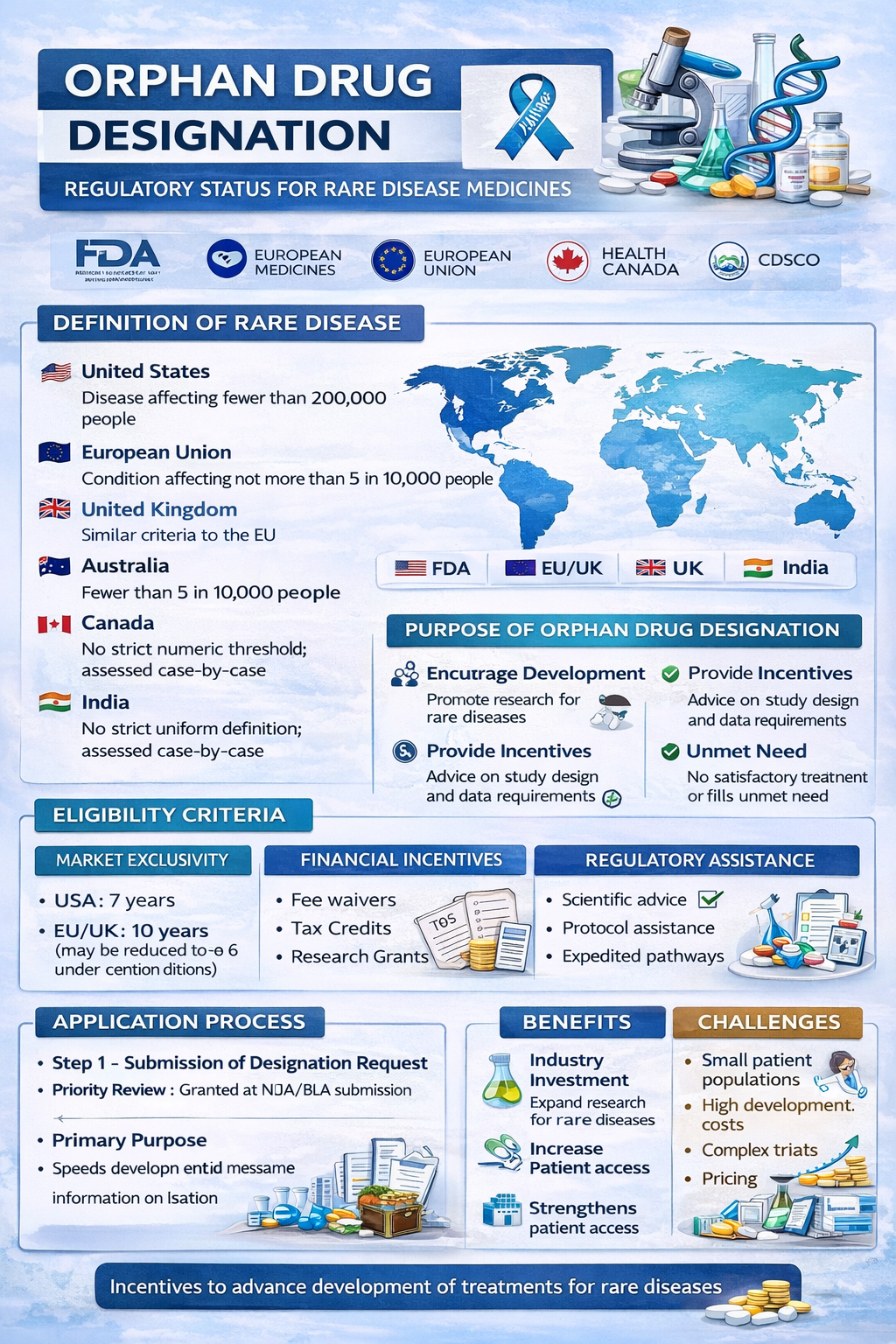 Definition of Rare Disease
The definition of a rare disease varies by region.
| Region |
Definition |
| United States |
Disease affecting fewer than 200,000 people |
| European Union |
Condition affecting not more than 5 in 10,000 people |
| United Kingdom |
Similar criteria to the European Union |
| Australia |
Fewer than 5 in 10,000 people |
| Canada |
No strict numeric threshold; evaluated case-by-case |
| India |
No strict uniform definition; assessed case-by-case |
Purpose of Orphan Drug Designation
| Objective |
Description |
| Encourage Development |
Promote research for rare diseases |
| Provide Incentives |
Offer financial and regulatory benefits |
| Improve Patient Access |
Increase availability of therapies for rare conditions |
| Promote Innovation |
Support development in neglected therapeutic areas |
Eligibility Criteria
| Requirement |
Description |
| Indication |
Intended to treat, prevent, or diagnose a rare disease |
| Medical Plausibility |
Scientific rationale demonstrating potential benefit |
| Unmet Need |
No satisfactory treatment available or product provides significant benefit |
| Supporting Evidence |
Adequate scientific justification |
Regulatory Incentives
Market Exclusivity
| Region |
Exclusivity Period |
| United States |
7 years |
| European Union / United Kingdom |
10 years (may be reduced to 6 under certain conditions) |
| Australia |
5 years |
Market exclusivity prevents approval of similar products for the same indication during the exclusivity period.
Financial Incentives
| Type |
Availability |
| Fee Waivers or Reductions |
Provided in multiple regions |
| Tax Credits |
Available in the United States |
| Research Grants |
Available in the United States |
| Reduced Evaluation Fees |
European Union, United Kingdom, Australia |
Regulatory Assistance
| Support Mechanism |
Description |
| Scientific Advice |
Regulatory guidance on development strategy |
| Protocol Assistance |
Study design recommendations |
| Early Engagement |
Pre-submission meetings |
| Expedited Pathways |
Potential eligibility for accelerated programs |
Application Process
| Step |
Description |
| Submission of Designation Request |
Sponsor submits epidemiological data, scientific rationale, mechanism of action, and information on existing therapies |
| Evaluation |
Authority assesses prevalence, medical plausibility, and significant benefit |
| Grant of Designation |
Orphan status granted; incentives become applicable |
Important Clarification
Orphan Drug Designation is separate from marketing authorization. Even after designation is granted, the product must undergo full clinical development and submit a complete NDA, MAA, or equivalent application before approval for marketing.
Benefits of Orphan Drug Programs
| Benefit |
Impact |
| Industry Investment |
Encourages development for small populations |
| Research Advancement |
Supports innovation in genetic and metabolic disorders |
| Targeted Therapies |
Expands availability of precision medicines |
| Patient Access |
Improves treatment options for rare diseases |
Challenges
| Challenge |
Explanation |
| Limited Patient Population |
Difficulty enrolling clinical trials |
| High Cost per Patient |
Increased development expense |
| Complex Study Design |
Statistical and methodological constraints |
| Pricing and Access Issues |
Affordability and reimbursement concerns |
Orphan Drug Designation provides structured regulatory incentives to stimulate development in rare disease areas while maintaining requirements for safety, efficacy, and quality through full regulatory approval processes.

 Sign in with Google
