 Sign in with Google

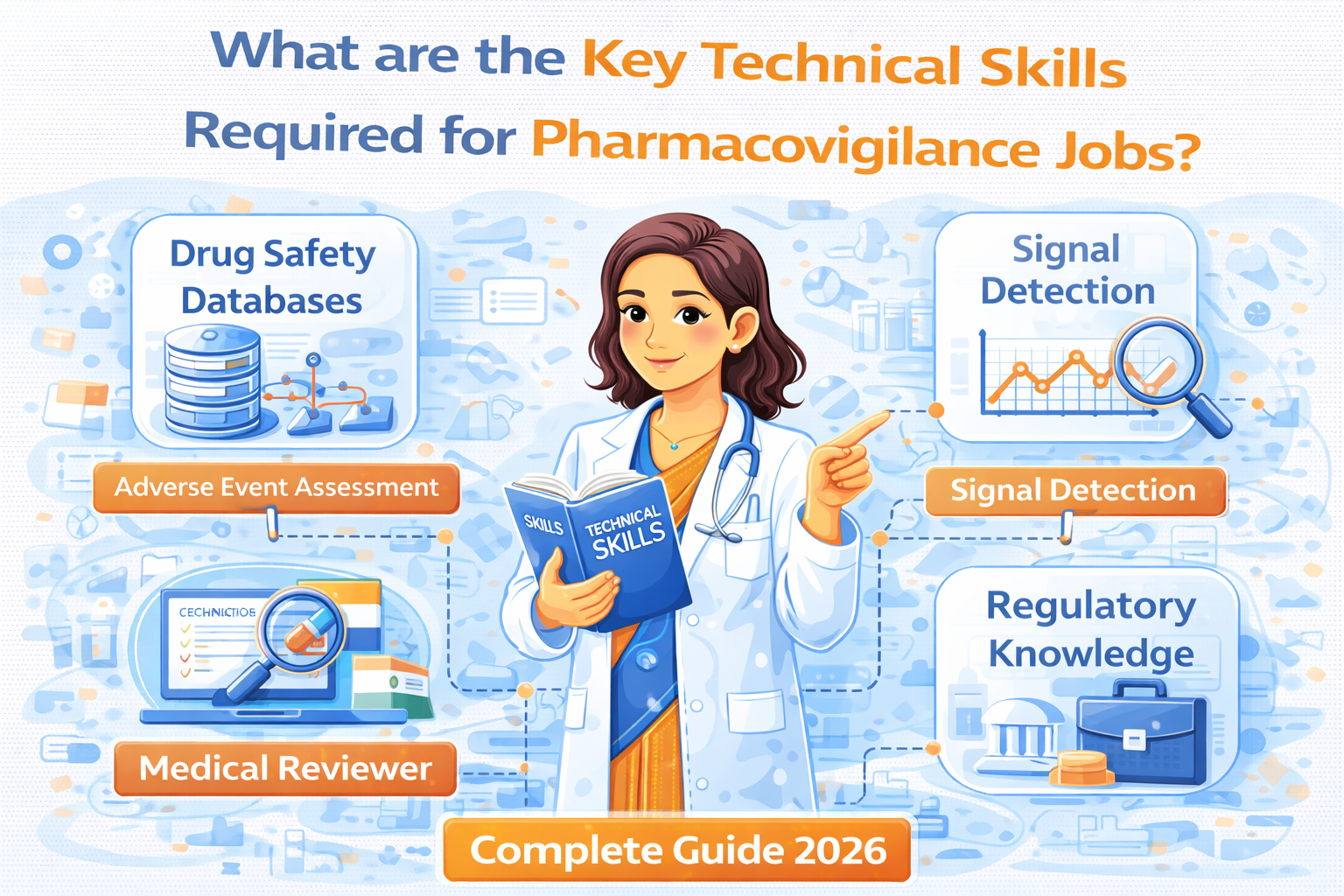
What are the Key Technical Skills Required for Pharmacovigilance Jobs?
What Recruiters Look for in Pharmacovigilance Candidates?
Pharmacovigilance is no longer just about processing Individual Case Safety Reports (ICSRs). It has evolved into a highly regulated, data-driven, globally monitored function that directly impacts patient safety and regulatory compliance.
If you are preparing for pharmacovigilance jobs in India or globally, understanding what recruiters actually look for can dramatically improve your selection chances.
At ThePharmaDaily, we consistently interact with hiring managers, PV team leads, and global delivery heads. The pattern is clear: recruiters are not only evaluating theoretical knowledge. They are assessing job-readiness, regulatory clarity, database exposure, and practical competence.
This article explains the key technical skills required for pharmacovigilance jobs and how structured pharmacovigilance training can bridge the gap between academic knowledge and industry expectations.
If you are serious about entering the field, start with structured pharmacovigilance training here:
https://thepharmadaily.com/pharmacovigilance-training
1. Strong Understanding of Pharmacovigilance Fundamentals
Recruiters expect candidates to clearly understand:
-
What is pharmacovigilance?
-
Definition of adverse event (AE) and adverse drug reaction (ADR)
-
Difference between serious and non-serious events
-
Four minimum criteria for valid ICSR
-
Role of regulatory authorities
Without conceptual clarity, even database skills will not help.
High-ranking recruiters often begin interviews with scenario-based questions:
-
Is this case valid?
-
Is it serious?
-
What is Day 0?
-
What is the reporting timeline?
Structured pharmacovigilance training ensures these fundamentals are not just memorized but understood with real case simulations. At ThePharmaDaily, practical exposure is integrated into the curriculum so candidates can confidently answer regulatory questions.
Explore structured industry-oriented pharmacovigilance training:
https://thepharmadaily.com/pharmacovigilance-training
2. ICSR Case Processing Expertise
One of the most critical technical skills required for pharmacovigilance jobs is end-to-end ICSR processing knowledge.
Recruiters look for familiarity with:
-
Case intake
-
Triage
-
Data entry
-
Narrative writing
-
MedDRA coding
-
Causality assessment
-
Seriousness assessment
-
Expectedness evaluation
-
Submission timelines
Candidates who have completed hands-on pharmacovigilance training are able to explain the complete workflow confidently.
In interviews, recruiters may ask:
-
How do you write a patient narrative?
-
How do you identify seriousness criteria?
-
What are the reporting timelines for serious cases?
Practical pharmacovigilance training at ThePharmaDaily focuses on real-time case processing exercises instead of purely theoretical lectures.
Build your ICSR processing skills through industry-aligned pharmacovigilance training:
https://thepharmadaily.com/pharmacovigilance-training
3. Knowledge of Global Regulatory Guidelines
Recruiters expect awareness of international pharmacovigilance regulations, especially:
-
ICH Guidelines (E2A, E2B, E2D)
-
GVP Modules
-
US FDA reporting requirements
-
EMA safety reporting frameworks
Candidates applying for pharmacovigilance associate or drug safety associate roles must demonstrate regulatory awareness.
Even entry-level positions require basic knowledge of:
-
Expedited reporting
-
7-day and 15-day reporting
-
Periodic Safety Update Reports (PSUR)
-
Risk Management Plans (RMP)
Without structured pharmacovigilance training, many candidates struggle with regulatory clarity. ThePharmaDaily ensures that global regulatory frameworks are simplified and explained with case-based examples.
Access globally focused pharmacovigilance training here:
https://thepharmadaily.com/pharmacovigilance-training
4. Safety Database Exposure
Recruiters strongly prefer candidates who have exposure to safety databases such as:
-
Argus Safety
-
ARISg
-
Veeva Safety
-
Oracle Safety Systems
While freshers may not always get live database access, mock simulations during pharmacovigilance training significantly increase selection chances.
Recruiters frequently ask:
-
Have you worked on any safety database?
-
Can you explain the data entry workflow?
Candidates trained through structured pharmacovigilance training programs at ThePharmaDaily gain familiarity with system workflows and data fields, making them more confident during interviews.
Enhance your database readiness through practical pharmacovigilance training:
https://thepharmadaily.com/pharmacovigilance-training
5. MedDRA Coding Skills
Medical Dictionary for Regulatory Activities (MedDRA) coding is a core technical requirement.
Recruiters expect candidates to understand:
-
Lowest Level Term (LLT)
-
Preferred Term (PT)
-
System Organ Class (SOC)
-
Proper coding hierarchy
Incorrect coding can affect signal detection and regulatory compliance. Therefore, candidates trained in accurate coding techniques during pharmacovigilance training are highly valued.
ThePharmaDaily integrates MedDRA exercises within its pharmacovigilance training modules to build coding precision and regulatory alignment.
Strengthen your MedDRA skills with structured pharmacovigilance training:
https://thepharmadaily.com/pharmacovigilance-training
6. Narrative Writing and Medical Writing Skills
Narrative writing is often underestimated but critically evaluated.
Recruiters assess:
-
Logical sequencing
-
Clarity
-
Medical accuracy
-
Conciseness
-
Regulatory compliance tone
Poor narrative writing can lead to case rejection or regulatory query.
Through structured pharmacovigilance training at ThePharmaDaily, candidates practice narrative drafting using real-world case scenarios to meet global standards.
Improve narrative and medical documentation skills through professional pharmacovigilance training:
https://thepharmadaily.com/pharmacovigilance-training
7. Data Accuracy and Attention to Detail
Pharmacovigilance is compliance-sensitive. Even minor data errors can result in regulatory findings.
Recruiters look for:
-
Accuracy in data extraction
-
Logical consistency
-
Timeline awareness
-
Error identification ability
Candidates who have undergone detailed pharmacovigilance training develop a disciplined approach toward case review and data validation.
At ThePharmaDaily, pharmacovigilance training emphasizes quality checks, case review checkpoints, and audit awareness.
Develop precision-driven skills through structured pharmacovigilance training:
https://thepharmadaily.com/pharmacovigilance-training
8. Communication and Interview Readiness
Technical knowledge alone is not enough. Recruiters evaluate:
-
Clarity in explanation
-
Confidence in case discussion
-
Practical examples
-
Regulatory reasoning
Many candidates fail interviews not due to lack of knowledge but due to poor articulation.
ThePharmaDaily integrates mock interview preparation within its pharmacovigilance training to ensure candidates are recruiter-ready.
Prepare for real interviews with industry-oriented pharmacovigilance training:
https://thepharmadaily.com/pharmacovigilance-training
Why Pharmacovigilance Training is Essential in 2026 and Beyond?
The pharmacovigilance industry is becoming more automated, globally regulated, and compliance-intensive. Recruiters are increasingly filtering candidates based on practical exposure rather than academic degrees alone.
Structured pharmacovigilance training:
-
Builds job-ready skills
-
Reduces onboarding time for employers
-
Improves interview performance
-
Enhances regulatory confidence
-
Increases placement probability
At ThePharmaDaily, pharmacovigilance training is designed with real recruiter expectations in mind. The goal is not just certification, but employability.
If your objective is to secure pharmacovigilance jobs with confidence and technical competence, begin with structured pharmacovigilance training here:
https://thepharmadaily.com/pharmacovigilance-training
Final Thoughts: What Recruiters Truly Look For?
Recruiters in pharmacovigilance are looking for:
-
Regulatory clarity
-
Case processing competence
-
Database awareness
-
Coding accuracy
-
Narrative precision
-
Attention to detail
-
Interview confidence
Candidates who combine these technical skills with structured pharmacovigilance training consistently outperform others in hiring processes.
If you want to position yourself as a strong candidate in the competitive pharmacovigilance job market, the right training makes the difference.
Start your career transformation today with professional pharmacovigilance training at ThePharmaDaily:
https://thepharmadaily.com/pharmacovigilance-training