 Sign in with Google


Top Pharmacovigilance Interview Questions for Freshers in 2026
Introduction
Pharmacovigilance has emerged as one of the most stable and high-growth career options within the pharmaceutical and clinical research industry. With strict global regulations and increasing patient safety awareness, every pharmaceutical company is legally obligated to monitor drug safety throughout the product lifecycle.
This has created continuous demand for trained pharmacovigilance professionals — especially freshers who possess strong fundamentals, regulatory clarity, and hands-on exposure.
However, pharmacovigilance interviews are highly concept-driven. Recruiters do not simply test definitions; they evaluate how well a candidate understands real-world safety workflows, decision-making logic, and regulatory responsibilities.
This blog provides deeply explained pharmacovigilance interview questions and answers for freshers, written exactly as interviewers expect.
Why Pharmacovigilance is a High-Demand Career?
Pharmacovigilance plays a critical role after a drug reaches the market. Clinical trials involve limited populations, but real-world usage exposes medicines to millions of patients with different ages, comorbidities, and concomitant medications.
Because of this:
-
Regulatory agencies mandate continuous safety monitoring
-
Adverse reactions may appear years after approval
-
Post-marketing surveillance is legally compulsory
-
Non-compliance leads to heavy penalties and product withdrawal
As a result, companies prefer candidates who have completed professional pharmacovigilance training and understand safety operations practically.
Detailed Pharmacovigilance Interview Questions and Answers
1. What is pharmacovigilance?
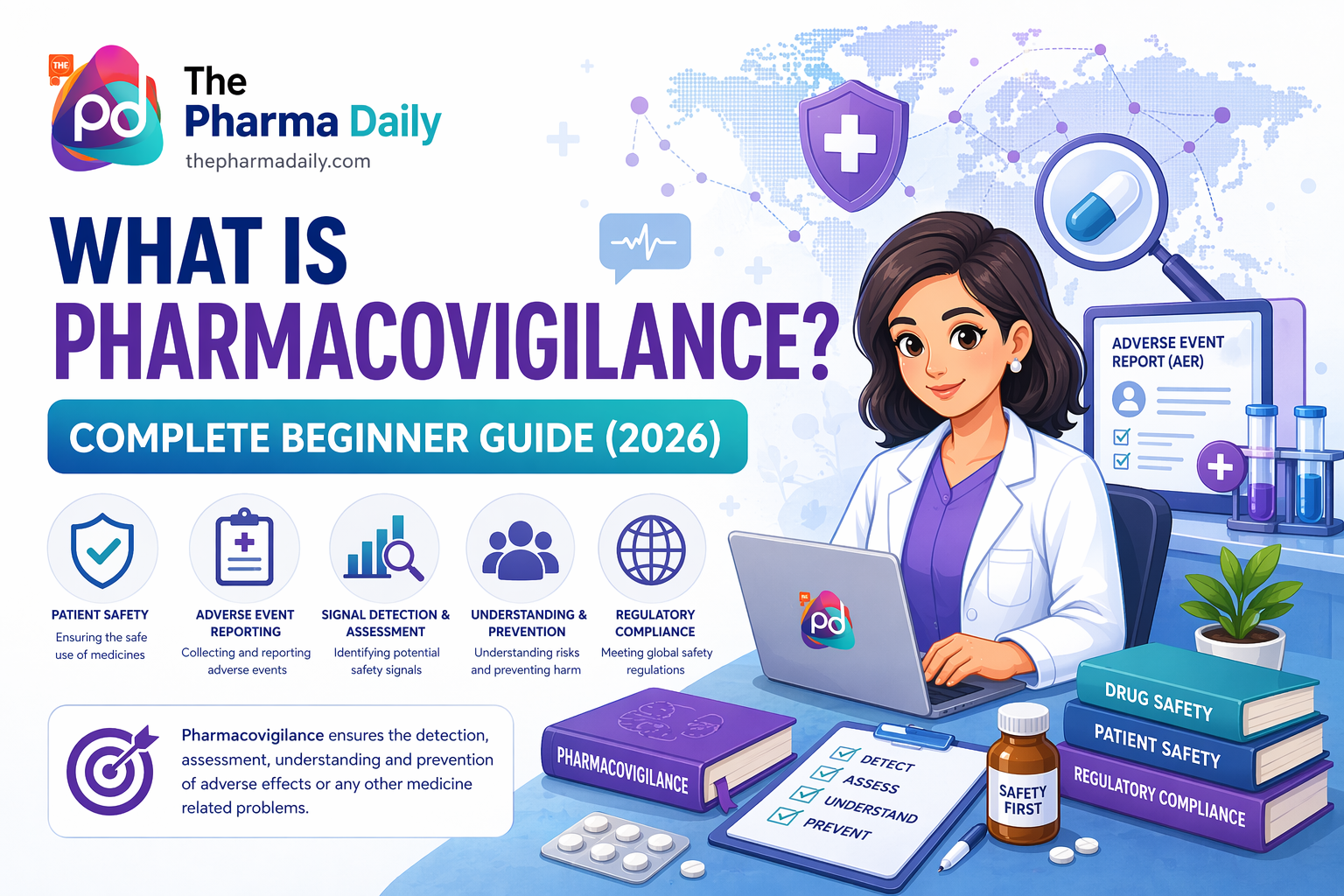
Pharmacovigilance is the science and set of activities related to the detection, assessment, understanding, and prevention of adverse effects or any other drug-related problems.
In simple terms, pharmacovigilance ensures that medicines available in the market remain safe for patients throughout their lifecycle.
It involves:
-
Monitoring adverse events
-
Identifying new safety signals
-
Updating product labels
-
Communicating risks to healthcare professionals
-
Maintaining a favorable benefit–risk profile
2. What is an adverse event (AE)?
An adverse event is any unfavorable or unintended medical occurrence in a patient who has been administered a medicinal product, regardless of whether it is related to the drug.
Key points:
-
Causality is not required
-
Can occur due to disease progression
-
May be coincidental
Example: A patient develops fever after taking a drug — relationship unknown.
3. What is an adverse drug reaction (ADR)?
An adverse drug reaction is a noxious and unintended response to a medicinal product where a causal relationship is at least reasonably possible.
Unlike an AE, ADR implies drug involvement.
Example: Patient develops rash known to be associated with the drug.
4. Difference between AE and ADR
| AE | ADR |
|---|---|
| No causal relationship required | Causality suspected |
| Broad definition | Narrow definition |
| Includes unrelated events | Drug-related reactions |
5. What is the aim of pharmacovigilance?
The primary objectives include:
-
Early detection of unknown adverse reactions
-
Identification of risk factors
-
Continuous benefit–risk evaluation
-
Prevention of patient harm
-
Regulatory compliance
Ultimately, pharmacovigilance protects public health.
6. What is an Individual Case Safety Report (ICSR)?
An ICSR is a structured safety report containing information about:
-
One identifiable patient
-
One or more suspected drugs
-
One or more adverse events
-
One identifiable reporter
ICSRs form the backbone of pharmacovigilance case processing.
7. What are the four minimum criteria for a valid case?
A case is considered valid only if it contains:
-
Identifiable patient
-
Identifiable reporter
-
Suspected medicinal product
-
Adverse event or reaction
If any element is missing, the case is invalid and not reportable.
8. What is Day 0?
Day 0 is the date when the company first becomes aware of a valid ICSR.
Regulatory reporting timelines begin from Day 0.
Incorrect Day 0 calculation can result in regulatory non-compliance.
9. What is seriousness in pharmacovigilance?
Seriousness refers to the outcome of the adverse event, not its intensity.
An event is serious if it:
-
Results in death
-
Is life-threatening
-
Requires hospitalization or prolongs hospitalization
-
Results in persistent disability
-
Causes congenital anomaly
-
Is medically significant
10. Difference between serious and severe
-
Serious: Regulatory classification based on outcome
-
Severe: Describes intensity (mild, moderate, severe)
A headache can be severe but not serious.
11. What is causality assessment?
Causality assessment evaluates the likelihood that a drug caused an adverse event.
Common tools include:
-
WHO-UMC causality scale
-
Naranjo algorithm
Categories include certain, probable, possible, unlikely, conditional, and unassessable.
12. What is dechallenge and rechallenge?
-
Dechallenge: Event improves after stopping the drug
-
Rechallenge: Event reappears after re-administration
Positive rechallenge provides strong evidence of causality.
13. What is expectedness?
Expectedness determines whether an adverse reaction is listed in:
-
SmPC
-
USPI
-
Investigator Brochure
If not listed, the event is considered unexpected.
14. What is SUSAR?
SUSAR stands for Suspected Unexpected Serious Adverse Reaction occurring during clinical trials.
These cases require expedited regulatory reporting.
15. What is MedDRA?
MedDRA is a standardized medical terminology used for:
-
Coding adverse events
-
Medical history
-
Indications
It ensures consistency across global safety databases.
16. What are expedited reporting timelines?
-
Fatal or life-threatening SUSAR: 7 days
-
Other serious unexpected cases: 15 days
Timelines are calculated from Day 0.
17. What is E2B reporting?
E2B is an electronic data exchange standard used to transmit ICSRs between:
-
Marketing authorization holders
-
Regulatory authorities
18. What is aggregate reporting?
Aggregate reports evaluate cumulative safety data and include:
-
PSUR
-
PBRER
-
DSUR
These reports assess benefit–risk balance periodically.
19. What is signal detection?
Signal detection identifies new or changing safety information that may require regulatory action.
Signals are evaluated using quantitative and qualitative methods.
20. What is a Risk Management Plan (RMP)?
An RMP describes:
-
Identified and potential risks
-
Pharmacovigilance activities
-
Risk minimization measures
It is mandatory for product approval.
21. Why pharmacovigilance training is important for freshers
Most companies prefer candidates who understand real-world safety workflows.
A structured pharmacovigilance training program helps freshers learn:
-
Live ICSR processing
-
Case triage
-
Narrative writing
-
MedDRA coding
-
Regulatory timelines
At ThePharmaDaily, our industry-aligned pharmacovigilance training prepares candidates exactly as per global company expectations.
Explore the complete course here:
https://thepharmadaily.com/pharmacovigilance-training
Why Choose Pharmacovigilance Training at ThePharmaDaily?
The 3 months hands-on pharmacovigilance training at ThePharmaDaily includes:
-
Real-life case studies
-
Live database simulation
-
Regulatory guideline training
-
Interview-focused preparation
-
Mentor-led support
This structured pharmacovigilance training significantly increases interview success rates.
Learn more:
https://thepharmadaily.com/pharmacovigilance-training
Conclusion
Pharmacovigilance interviews test conceptual clarity, regulatory understanding, and practical awareness.
With growing competition, completing professional pharmacovigilance training from ThePharmaDaily can dramatically improve your confidence and hiring chances.
If you are serious about building a long-term career in drug safety, hands-on training combined with strong fundamentals is the key to success.
For full details, visit:
https://thepharmadaily.com/pharmacovigilance-training
Published by ThePharmaDaily – Your Trusted Platform for Pharmacovigilance Training and Career Growth.