 Sign in with Google


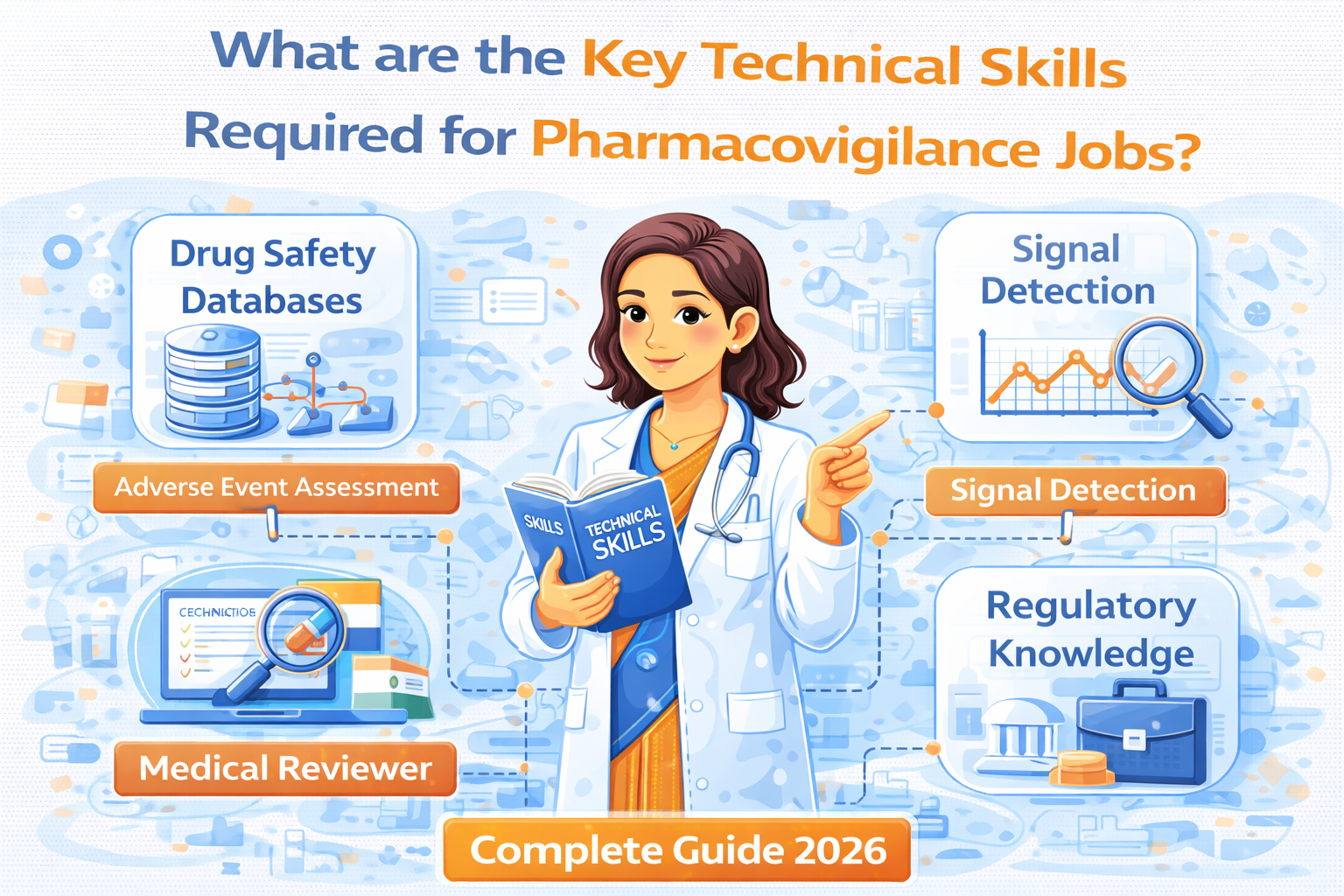
Technical Skills Required for Pharmacovigilance Jobs in India
Introduction: Why Technical Skills Matter in Pharmacovigilance
Pharmacovigilance is no longer limited to basic adverse event reporting. With increasing global regulatory scrutiny, advanced safety databases, automation tools, and strict compliance timelines, pharmaceutical companies today demand highly skilled pharmacovigilance professionals.
Whether you are a fresher, pharmacy graduate, medical graduate, or a working professional planning to enter drug safety, understanding the technical skills required for pharmacovigilance jobs in India is the foundation of long-term career success.
Employers hiring for pharmacovigilance roles at companies such as IQVIA, Accenture, TCS, Cognizant, ICON, Parexel, Syneos, and Labcorp now prioritize hands-on pharmacovigilance training, practical exposure, and real-case understanding over theory alone.
This detailed guide breaks down every essential technical skill you must master to become job-ready.
What Are Technical Skills in Pharmacovigilance?
Technical skills in pharmacovigilance refer to the practical, system-based, regulatory, and analytical competencies required to process, assess, and report drug safety data in compliance with global health authorities.
These skills are typically developed through structured pharmacovigilance training programs, industry projects, and real-time case simulations.
At ThePharmaDaily, pharmacovigilance training is designed specifically to bridge the gap between academic knowledge and real industry expectations.
Core Technical Skills Required for Pharmacovigilance Jobs
1. Individual Case Safety Report (ICSR) Processing
ICSR processing is the backbone of pharmacovigilance operations.
Professionals must be able to:
-
Identify valid and invalid cases
-
Extract minimum criteria (patient, reporter, suspect drug, adverse event)
-
Perform accurate data entry
-
Write clear patient narratives
-
Conduct seriousness assessment
-
Determine expectedness using product labels
-
Identify adverse drug reactions
ICSR processing requires strong medical understanding and precision, which is why comprehensive pharmacovigilance training with case-based learning is critical.
Learn more through ThePharmaDaily pharmacovigilance training program:
https://thepharmadaily.com/pharmacovigilance-training
2. MedDRA Coding Skills
Medical Dictionary for Regulatory Activities (MedDRA) is used globally for coding adverse events, indications, and medical history.
Essential MedDRA skills include:
-
Understanding SOC, HLGT, HLT, PT, and LLT structure
-
Accurate adverse event coding
-
Selecting medically appropriate terms
-
Avoiding overcoding and undercoding
-
Version management and updates
Recruiters specifically test MedDRA knowledge during interviews, making it one of the most important technical competencies gained during pharmacovigilance training.
3. WHO Drug Dictionary (WHO-DD) Coding
Drug coding ensures consistency in global safety databases.
Professionals must know:
-
Generic vs brand name identification
-
Active ingredient mapping
-
Salt selection
-
Drug role coding (suspect, concomitant, interacting)
-
WHO-DD structure and updates
Strong WHO-DD knowledge significantly improves employability for pharmacovigilance roles.
4. Seriousness and Expectedness Assessment
A critical responsibility in pharmacovigilance is determining whether a case is serious.
Professionals must assess:
-
Death
-
Life-threatening events
-
Hospitalization
-
Disability
-
Congenital anomaly
-
Medically important conditions
Expectedness assessment requires comparison with:
-
Company Core Safety Information (CCSI)
-
Investigator Brochure (IB)
-
Summary of Product Characteristics (SmPC)
-
Package Insert (PI)
This skill is heavily emphasized during advanced pharmacovigilance training at ThePharmaDaily.
https://thepharmadaily.com/pharmacovigilance-training
5. Regulatory Reporting Knowledge
Pharmacovigilance professionals must understand global reporting timelines:
-
US FDA (FAERS)
-
EMA (EudraVigilance)
-
MHRA
-
Health Canada
-
TGA Australia
-
CDSCO India
Key reporting timelines include:
-
7-day expedited reporting
-
15-day expedited reporting
-
Periodic reporting schedules
Failure to meet timelines can lead to regulatory penalties, making regulatory knowledge a core technical skill.
6. Safety Database Proficiency
Most companies work on validated pharmacovigilance databases such as:
-
Argus Safety
-
ArisG
n- Oracle Safety One -
Veeva Vault Safety
Professionals must know:
-
Case intake workflow
-
Data entry standards
-
Duplicate search
-
Case versioning
-
Follow-up management
-
Quality checks
n
Hands-on exposure through pharmacovigilance training platforms significantly improves job readiness.
7. Narrative Writing Skills
Narrative writing transforms raw case data into a medically coherent story.
Strong narratives must:
-
Follow chronological order
-
Maintain medical accuracy
-
Include lab results, timelines, outcomes
-
Reflect causality clearly
-
Follow global narrative standards
Narrative writing is one of the most tested skills in pharmacovigilance interviews.
ThePharmaDaily pharmacovigilance training emphasizes long-format narrative case writing for this reason.
https://thepharmadaily.com/pharmacovigilance-training
8. Signal Detection and Safety Review
At advanced levels, pharmacovigilance professionals participate in:
-
Signal identification
-
Case series analysis
-
Trend evaluation
-
Benefit–risk assessment
Tools and techniques include:
-
PRR
-
ROR
-
Bayesian methods
-
Case clustering
These skills are essential for safety scientists and drug safety physicians.
9. Aggregate Reporting Knowledge
Aggregate reports summarize cumulative safety data.
Professionals should understand:
-
PSUR / PBRER
-
DSUR
-
Development Safety Update Reports
-
Annual Safety Reports
Knowledge of ICH E2C(R2) and E2F guidelines is highly valued.
10. Quality and Compliance Skills
Pharmacovigilance operates under strict quality systems.
Key knowledge areas include:
-
SOP compliance
-
Audit readiness
-
Inspection findings
-
CAPA management
-
Data privacy (GDPR)
Quality-focused professionals grow faster in global pharmacovigilance careers.
Supporting Technical Tools Knowledge
Additional skills that improve hiring chances:
-
Microsoft Excel (line listings, trackers)
-
Medical terminology
-
Clinical trial fundamentals
-
GxP regulations
-
Basic understanding of clinical research lifecycle
All of these are integrated into structured pharmacovigilance training programs.
Why Pharmacovigilance Training is Essential?
Academic degrees alone do not teach:
-
Live safety databases
-
Regulatory timelines
-
Real ICSR case scenarios
-
Global inspection expectations
This is why certified pharmacovigilance training is now considered mandatory by recruiters.
ThePharmaDaily offers industry-focused pharmacovigilance training with:
-
Real-time ICSR cases
-
Database simulations
-
MedDRA and WHO-DD practice
-
Narrative writing projects
-
Regulatory documentation exposure
Explore the complete training program here:
https://thepharmadaily.com/pharmacovigilance-training
Career Opportunities After Pharmacovigilance Training
With the right technical skills, professionals can work as:
-
Drug Safety Associate
-
Pharmacovigilance Executive
-
Case Processing Specialist
-
Safety Scientist
-
Aggregate Report Writer
-
Signal Detection Analyst
-
PV Quality Specialist
India continues to be one of the largest global pharmacovigilance hubs.
Final Thoughts
The demand for skilled pharmacovigilance professionals is rising rapidly due to increasing drug development, post-marketing surveillance, and global regulatory enforcement.
Mastering the technical skills listed above through structured pharmacovigilance training is the most reliable way to secure a stable, high-growth career in drug safety.
If your goal is to build a strong pharmacovigilance profile aligned with current industry hiring standards, start with comprehensive training that focuses on practical exposure.
Visit ThePharmaDaily’s official pharmacovigilance training page to begin your journey:
https://thepharmadaily.com/pharmacovigilance-training
Keywords Used:
pharmacovigilance training, pharmacovigilance jobs in India, technical skills for pharmacovigilance, ICSR processing, MedDRA coding, WHO drug dictionary, drug safety training, ThePharmaDaily pharmacovigilance training